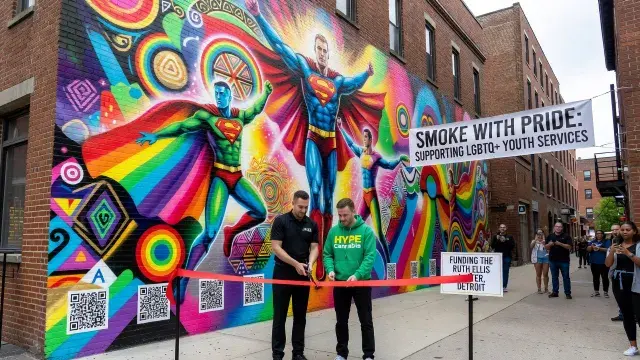
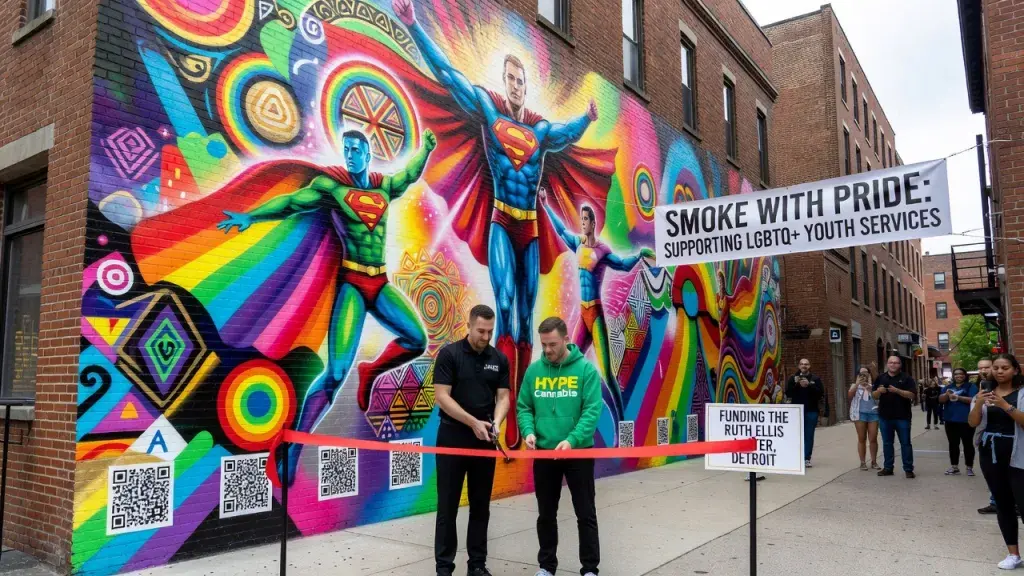
Two Michigan cannabis retailers put their marketing budget toward something other than a discount promotion this month. JARS Cannabis and HYPE Cannabis cut the ribbon on "Polychromatic Super You," a 40-by-25-foot mural by Michigan artist Joey Salamon, tucked into an alley off W. Nine Mile Rd. in downtown Ferndale. The piece anchors the companies' joint Smoke with Pride campaign, which directs a share of product proceeds to Detroit's Ruth Ellis Center, a support organization for at-risk LGBTQ+ youth.
The mechanics of the campaign are worth a closer look, because they reveal how licensed retailers are experimenting with cause marketing inside a regulatory environment that still restricts a lot of traditional advertising. Ten percent of proceeds from HYPE products sold at JARS locations goes to the Ruth Ellis Center, and 100 percent of proceeds from a co-branded Smoke with Pride kit follows the same path. That structure lets both brands report a measurable donation figure without running afoul of promotional rules that govern discounting and giveaways in adult-use retail. For operators watching how peers manage brand visibility under advertising restrictions, this kind of tiered-giving model is a useful reference point - and it's the sort of donor tracking that increasingly runs through the same systems retailers use for loyalty and customer engagement, the same category of tools covered by platforms like cannabis crm maryland that many multi-state operators rely on to segment purchases and manage compliant customer communication.
Public Art as a Compliance-Friendly Marketing Channel
Cannabis advertising rules vary by state, but a common thread runs through most of them: retailers face tighter limits on signage, sponsorship, and community-facing promotion than a typical retail business does. Michigan, like many adult-use markets, restricts cannabis advertising near schools and limits how retailers can market to the general public. A commissioned mural sidesteps a lot of that friction. It's not a billboard pitching a product line; it's public art with a QR code attached, and the code routes visitors to information about a nonprofit rather than a menu of SKUs. That distinction matters for compliance teams weighing how far a brand campaign can go before it crosses into restricted advertising territory.
Why the Cannabis-LGBTQ+ Connection Gets Cited So Often
JARS Cannabis Marketing Director Stefanie Michels framed the mural as a nod to overlapping histories between cannabis culture and LGBTQ+ organizing, both movements that operated outside mainstream acceptance for decades before gaining broader legal and social recognition. Artist Joey Salamon, who identifies as queer, said the project stood out because JARS and HYPE gave him creative latitude rather than dictating the design. For a heavily regulated industry still working to shed stigma left over from prohibition, that kind of storytelling does real reputational work - it signals to municipal partners, landlords, and community boards that a licensed retailer can be a civic asset rather than a nuisance tenant.
What Operators Should Take From This
Community investment like this isn't charity in the purest sense; it's also a zoning and licensing strategy. Local governments that approve dispensary permits often weigh community benefit alongside tax revenue projections, and a visible, non-controversial public art commission can shift how a municipality views a cannabis tenant during license renewal or expansion conversations. That's a practical lesson for other operators, particularly in markets where local approval remains discretionary and community pushback can stall a build-out. None of that changes the underlying facts of the product being sold: adult-use cannabis remains restricted to buyers 21 and older, subject to lab testing and compliant packaging requirements, and retailers promoting causes still need to keep their marketing separate from anything resembling a sales incentive tied to age-restricted goods.