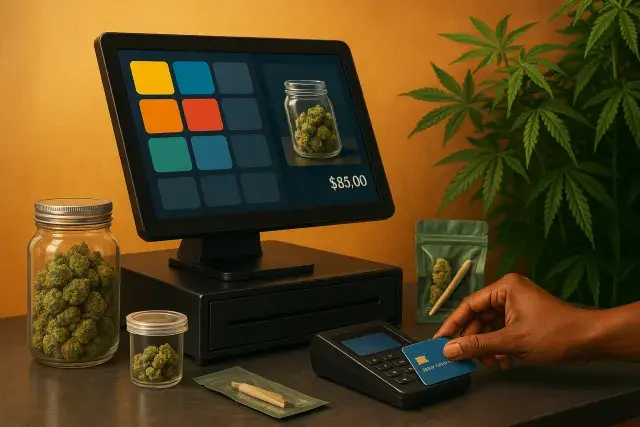

Running a dispensary without purpose-built software is a bit like performing surgery with general-purpose tools - technically possible, but unnecessarily risky and imprecise. Cannabis retail operates under a unique convergence of pressures: strict state and local compliance mandates, real-time inventory obligations, age and dosage verification requirements, and customers who expect a retail experience comparable to any modern specialty store. General-purpose point of sale systems were never designed for this environment, and the gaps they leave behind are exactly where dispensaries lose money, fail audits, and frustrate patients.
The rise of the MMJ point-of-sale category represents a direct industry response to those gaps. These platforms are built from the ground up to handle the specific workflows cannabis retailers face daily - from patient verification at check-in to automated state reporting at the end of a transaction. Understanding what separates a capable cannabis retail POS system from a retrofitted workaround is essential for any dispensary operator making technology decisions today.
This piece covers the full operational picture: how purpose-built dispensary point of sale software changes the checkout experience, what it actually does for inventory accuracy, and why compliance is no longer a manual burden when the right system is in place. Whether you are opening a first location or reconsidering your current setup, the following sections lay out exactly what modern cannabis POS infrastructure looks like - and what it delivers.
What Makes a Cannabis Retail POS System Different from General POS Software
The Regulatory Context That Shapes Every Feature
Cannabis retail does not operate in a vacuum. Every state with a legal medical or adult-use market has established a regulatory framework that dictates how products are tracked, how sales are recorded, and what information must be reported to oversight agencies. In many states, that reporting flows directly into seed-to-sale tracking systems such as Metrc or BioTrackTHC. A general retail POS - even a sophisticated one built for restaurants or boutiques - has no native mechanism to connect to these systems. It cannot push or pull data from state databases, cannot flag purchase limits, and cannot generate the reports regulators require.
A cannabis retail POS system is architected with those connections built in. The regulatory layer is not a plugin or an afterthought - it is part of the core data model. When a transaction is processed, the system simultaneously logs it in the dispensary's internal records and transmits the required manifest data to the state system. This design choice eliminates an entire category of human error that dispensaries using disconnected systems have to manage manually.
Patient and Customer Management Features
Medical dispensaries carry an additional layer of responsibility that recreational-only retailers do not face to the same degree: verifying patient eligibility before any sale occurs. This means confirming that a patient holds a valid medical marijuana card, that the card has not expired, and that the purchase does not exceed the legal possession or purchase limit for their jurisdiction. A dispensary point of sale software solution handles this at intake - scanning or entering the patient ID triggers a real-time eligibility check, flags any issues, and records the interaction as part of the patient's purchase history.
Beyond eligibility, robust patient profiles allow staff to see previous purchases, note product sensitivities or preferences, and ensure that recommendations stay within both regulatory and therapeutic parameters. This is particularly relevant in medical settings where patients may be managing chronic conditions and depend on consistent product guidance from their care team or budtenders.
Hardware Requirements and Integration Points
The hardware ecosystem for cannabis POS is also distinct. Dispensaries typically require ID scanners for age and card verification, barcode or RFID scanners for product intake and inventory management, label printers for patient-specific packaging, and often cash management drawers with reconciliation tools - given that many cannabis businesses still operate primarily in cash due to federal banking limitations. A purpose-built system accounts for these hardware dependencies, offering pre-tested compatibility rather than requiring operators to piece together components from multiple vendors.
Integration with digital menus, online ordering platforms, and loyalty programs adds another layer. A dispensary that uses a standalone online ordering tool disconnected from its POS creates inventory discrepancies and fulfillment delays. When those systems share a data layer, product availability, pricing, and patient limits stay synchronized across every customer touchpoint.
How Medical Marijuana Point of Sale Transforms the Patient Experience
Reducing Wait Times Through Workflow Optimization
In a busy medical dispensary, the check-in and checkout process can become a bottleneck that frustrates patients and limits throughput. When the medical marijuana point of sale system is designed around dispensary workflows, it streamlines every step - from queue management at the front desk to product lookup and payment processing at the register. Staff spend less time switching between systems or manually entering data, which directly reduces transaction time per patient.
Some dispensary POS platforms include pre-order capabilities where registered patients can submit their order before arriving. By the time they check in, the order is already confirmed against current inventory and their purchase limit. The transaction at the counter becomes a verification and payment step rather than a full consultation from scratch - meaningful time savings during peak hours.
Accurate Product Information at the Point of Sale
Medical patients make purchasing decisions based on product attributes that matter clinically: cannabinoid percentages, terpene profiles, strain lineage, and form factor. When product data from the intake and inventory system flows through to the POS display, budtenders can answer patient questions accurately without consulting a separate reference system or printed menu that may already be outdated.
Real-time product availability is equally important. Nothing undermines patient trust faster than recommending a product that turns out to be out of stock. When the POS and inventory management system share live data, the menu - whether displayed on a kiosk, a staff tablet, or a digital board - reflects only what is genuinely available. This is not just a convenience feature; it directly affects the quality of clinical guidance staff can provide.
Payment Flexibility and Cash Handling
Cannabis banking restrictions have created a retail environment where cash management systems need to be more robust than in typical retail. Sophisticated dispensary point of sale software includes integrated cash tracking, drawer management, and end-of-day reconciliation tools that minimize both errors and internal theft exposure. Some systems also support cashless ATM or debit payment processing solutions that comply with applicable financial regulations without requiring traditional merchant accounts.
Transparent transaction records matter for both patient trust and business accounting. When every payment method is logged within the POS with a clear audit trail, disputes are easy to resolve and cash flow reporting becomes accurate without hours of manual reconciliation.
Marijuana Inventory Management: The Operational Core of Any Dispensary
Seed-to-Sale Tracking and What It Requires from Software
Marijuana inventory management in a licensed dispensary is not optional or informal - it is a regulatory obligation. State tracking systems require that every unit of cannabis product carry a unique identifier from cultivation through final sale. When product arrives at a dispensary, it must be received into the state system, matched against the transfer manifest, and logged into the dispensary's own records before it can be placed on shelves or sold.
This receiving process, done manually, is time-consuming and error-prone. Purpose-built inventory software automates the reconciliation between the state manifest and the physical intake - staff scan product tags, the system matches them against the expected manifest, and any discrepancy triggers an immediate alert. What would otherwise take 30 to 60 minutes of manual data entry becomes a guided scan process that takes a fraction of the time and eliminates keying errors.
Real-Time Inventory Visibility Across Locations
For dispensary groups operating multiple locations, inventory visibility becomes a strategic issue as well as an operational one. Without a centralized system, each location manages its own stock independently, creating situations where one location is overstocked on slow-moving product while another runs out of the same item. Centralized marijuana inventory management allows purchasing decisions to be made with full visibility across the organization.
Automated reorder alerts, based on par levels set for each product category, prevent stockouts without requiring managers to manually monitor inventory daily. When a product drops below its threshold, the system flags it - or, in some cases, generates a draft purchase order. This kind of automated oversight is particularly valuable for medical products where patient continuity of supply matters.
Handling Returns, Waste, and Adjustments
Cannabis inventory is not static between receipts and sales. Products expire, packages are damaged, waste must be logged for state reporting, and the occasional return must be processed in a way that satisfies both the customer and the regulatory record. A dispensary operating without specialized software handles these events as exceptions - interruptions to a system that was not designed for them.
Dispensary-specific inventory software treats these as standard transaction types. A waste event, for example, generates both an internal adjustment and a corresponding entry in the state tracking system. A return triggers an inventory credit and updates purchase history. Every adjustment carries a timestamp, a staff ID, and a reason code - creating the kind of detailed audit trail that regulators expect to see during inspections.
Inventory Reporting for Business Intelligence
Beyond compliance, inventory data is a source of genuine business intelligence when it is captured and presented well. Which product categories turn over fastest? Which strains or form factors have the highest margin? What is the average basket size by time of day or patient type? These questions can only be answered when transaction data, inventory data, and patient purchase data are connected in a single system and surfaced through useful reports.
Dispensary operators who can answer these questions make better buying decisions, structure their menus more effectively, and identify underperforming SKUs before they tie up capital. The inventory system is not just a compliance tool - it is the foundation of data-driven retail management.
Cannabis POS Compliance: Turning Regulatory Requirements into Automated Processes
State Reporting and Seed-to-Sale Integration
Cannabis POS compliance is, in many ways, the non-negotiable differentiator between purpose-built dispensary software and anything else. Every state with a regulated cannabis market requires operators to report sales data to a designated tracking platform. The frequency, format, and content of those reports varies by state, but the obligation is consistent: every transaction must be recorded in both the dispensary's system and the state's system, and those records must match.
When the dispensary POS integrates directly with the state tracking system through an official API, this reporting happens automatically at the point of sale. The staff member completes the transaction, the system processes payment, and simultaneously transmits the required data to the state platform. If the connection fails or the state system is temporarily unavailable, a properly designed POS queues the data and transmits it as soon as connectivity is restored - without requiring manual intervention or creating a compliance gap.
Purchase Limit Enforcement
One of the most consequential compliance requirements in medical cannabis retail is purchase limit enforcement. Patients are legally permitted to purchase only a specified quantity of cannabis within a defined time period. Selling above that limit - even unintentionally - is a regulatory violation that can result in fines, license suspension, or worse.
A well-implemented cannabis retail POS system tracks each patient's purchase history in real time and calculates how much of their allowable limit they have used. Before a transaction is completed, the system checks whether the requested quantity would exceed the limit. If it would, the sale is blocked and the staff member is informed. This enforcement happens at the software level, which means it works consistently regardless of which staff member is serving the patient or how busy the dispensary is.
Age Verification and Audit Trails
Age verification is another area where manual processes introduce meaningful risk. Staff in a busy dispensary may feel pressure to skip or abbreviate the verification step during peak hours. When the POS requires ID scan as a mandatory step before any transaction can proceed, that shortcut is no longer available. The system enforces the workflow, and the scan event is logged as part of the transaction record.
Audit trails more broadly are a critical feature of cannabis POS compliance. Regulators conducting an inspection have the right to review transaction records, inventory adjustments, staff access logs, and reporting history. A system that logs every action - with user ID, timestamp, and transaction detail - can produce those records on demand. A system that does not creates a compliance exposure that no amount of internal policy can fully offset.
Managing Compliance Across Multiple Jurisdictions
Dispensary groups that operate across state lines face a compounded compliance challenge: each state has its own tracking system, its own purchase limit rules, its own required report formats, and its own inspection expectations. Software that handles compliance in one state may not be licensed or configured for another.
Multi-state operators benefit significantly from POS platforms that maintain up-to-date compliance configurations for each jurisdiction where they operate. Rather than managing separate software instances or relying on staff in each location to stay current with regulatory changes, the system absorbs those updates at the platform level and pushes them to the appropriate locations. This is one area where the scalability of a purpose-built solution pays clear dividends.
Choosing Dispensary Point of Sale Software: Key Evaluation Criteria
Compliance Coverage and State Approvals
Before evaluating any dispensary point of sale software on features or price, operators should confirm that the system is approved or actively used in their state. Some states maintain approved vendor lists; others rely on API certification with the state tracking system. A system that lacks official integration with the required state platform is not viable, regardless of its other capabilities.
Beyond current compliance, ask vendors how they handle regulatory updates. Cannabis regulations evolve - purchase limits change, new product categories are added, reporting requirements shift. A software vendor that requires manual configuration changes on the dispensary's side every time a regulation changes adds ongoing operational burden. The better approach is a platform that pushes compliance updates centrally, so locations receive them without needing local intervention.
Inventory Management Depth
Not all cannabis POS platforms offer the same depth of marijuana inventory management functionality. Some handle basic stock tracking and sales deduction but lack advanced features like multi-location visibility, automated reorder alerts, or detailed batch and lot tracking. Others offer full seed-to-sale capabilities that match what a vertically integrated operator - one that grows, processes, and sells - actually needs.
Evaluate inventory features against your current operation and your near-term growth plan. A single-location medical dispensary has different requirements than a multi-location retail group, and paying for features you do not need is as problematic as lacking ones you do.
Hardware Compatibility and Support
Technology decisions in cannabis retail are not purely software decisions. The physical environment - scanners, printers, cash drawers, displays, check-in tablets - must work reliably with the software platform chosen. Confirm compatibility before committing, and pay particular attention to the vendor's support model for hardware issues. A software bug can often be patched remotely; a failed receipt printer at the register during a busy weekend requires a different kind of response.
Support availability matters enormously in cannabis retail, where operating hours often extend into evenings and weekends. A vendor whose support team is only reachable Monday through Friday during business hours is a meaningful operational risk for a business that runs seven days a week.
Reporting and Analytics Capabilities
The value of a cannabis retail POS system is not limited to transaction processing and compliance. The data that flows through the system - every sale, every product, every patient visit - is a business asset when it can be analyzed and acted upon. Evaluate the reporting and analytics layer as seriously as the compliance features.
- Sales by product category, strain, and form factor
- Average transaction value by time of day, day of week, and staff member
- Inventory turnover rates and days of supply by SKU
- Patient retention and return visit frequency
- Purchase limit utilization across the patient base
These reports should be available without custom data exports or external analysis tools. If generating a basic sales summary requires pulling raw data into a spreadsheet, the reporting layer is not fit for operational use.
Implementation, Staff Training, and Getting the Most from Your POS Investment
Planning the Implementation Timeline
Switching POS platforms in an operating dispensary is not a weekend project. Between data migration, hardware setup, state system configuration, and staff training, a thorough implementation typically requires weeks of planning and a phased rollout approach. Attempting to cut that timeline creates operational risk - particularly around compliance, where configuration errors can result in failed state reports or blocked transactions.
Work with the vendor to define a realistic implementation schedule that includes a parallel operation period if possible - running the new system alongside the existing one long enough to verify that all data flows correctly before cutting over entirely. The investment in careful implementation pays back quickly in avoided errors.
Staff Training and Role-Based Access
Even the most capable dispensary software delivers limited value if staff are not trained to use it correctly. Training should be role-specific: budtenders need to understand the patient check-in flow, product lookup, and transaction completion; managers need to understand inventory adjustment procedures, reporting tools, and compliance monitoring dashboards; administrators need to understand user management and system configuration.
Role-based access controls also serve a compliance function. Staff should have access only to the system functions relevant to their role - a budtender should not be able to modify inventory records or adjust pricing, for example. Properly configured access controls reduce both error risk and the potential for internal fraud, and they generate cleaner audit trails because each action is attributed to a specific user role.
Ongoing Optimization After Go-Live
The first 90 days after a POS implementation are typically focused on stability - making sure the system works as expected, resolving any configuration issues, and building staff comfort with new workflows. After that period, the focus should shift to optimization: using the data the system generates to make better decisions.
Review inventory reports monthly to identify slow-moving products and adjust purchasing accordingly. Monitor transaction time metrics to identify bottlenecks in the patient flow. Use patient purchase history to identify opportunities for education or outreach. The cannabis retail POS system is a tool - its value compounds over time as the operator develops the habits and skills to act on what it reveals.
Frequently Asked Questions
Can a dispensary use a general retail POS system like Square or Shopify?
Technically possible for processing payments in some configurations, but neither platform integrates with state cannabis tracking systems, enforces purchase limits, or generates the compliance reports that licensed dispensaries are required to maintain. Using a general retail POS creates significant regulatory exposure and typically requires manual workarounds that scale poorly as volume grows.
How does a cannabis POS system connect to state tracking systems like Metrc?
State-integrated dispensary POS platforms connect to tracking systems like Metrc through official APIs. When a sale is completed, the system automatically transmits the required transaction data to the state platform in the required format. The specific data fields and transmission timing vary by state, but in a properly configured system, the connection is bidirectional - the POS can also pull manifest data from the state system when receiving inventory transfers.
What happens if the state tracking system goes down during business hours?
A well-designed cannabis retail POS system queues transactions locally when the state system is unavailable and transmits them as soon as the connection is restored. Some states permit a brief grace period for reporting during system outages; operators should confirm their state's policy and ensure their software vendor documents how outages are handled - both technically and procedurally.
How does the POS enforce per-patient purchase limits in real time?
The system maintains a running record of each patient's purchases within the defined limit period - typically a rolling number of days set by state regulation. When a patient begins a transaction, the POS calculates the total of their previous purchases plus the current requested items and compares that to the legal limit. If the cart would exceed the limit, the transaction is blocked or the quantity is capped, and the staff member is notified. This check happens before payment is processed.
Is marijuana inventory management handled differently for medical versus adult-use products?
The underlying inventory tracking mechanics are similar, but medical products may carry additional requirements - such as patient-specific labeling, dosage documentation, or segregated storage tracking in some jurisdictions. Dispensaries that serve both medical and adult-use patients in the same facility need software that can manage separate inventory categories and apply the correct purchase limit rules based on customer type at the point of sale.
How long does it typically take to implement a new dispensary POS system?
For a single-location dispensary switching from an existing system, a realistic implementation timeline runs from two to six weeks, depending on data migration complexity, hardware changes, and state integration requirements. New dispensaries going live for the first time can sometimes move faster, but should allow adequate time for state system configuration and staff training before opening to patients.