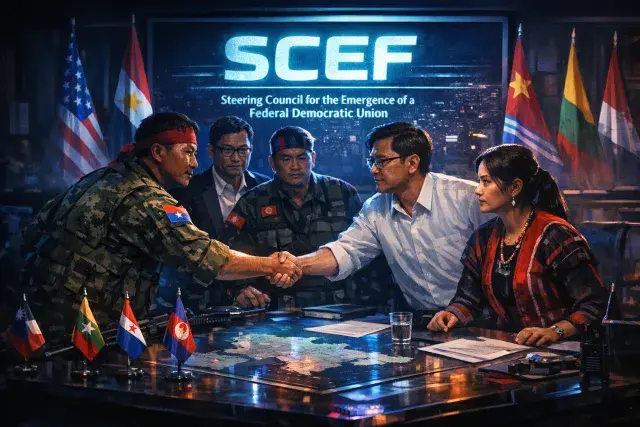
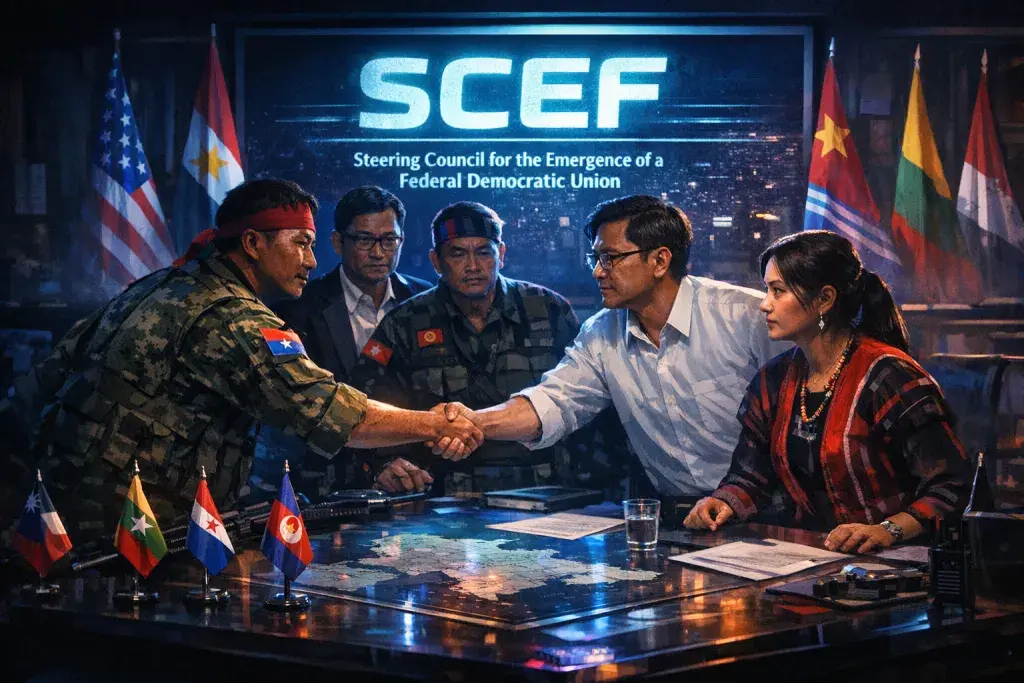
Resistance forces in Myanmar have launched the Steering Council for the Emergence of a Federal Democratic Union (SCEF), uniting the National Unity Government (NUG), the Committee Representing Pyidaungsu Hluttaw (CRPH), and four ethnic armed organizations. Announced on March 30, this coalition seeks to coordinate military and political efforts against the military junta, aiming for a swift victory and a new federal democratic framework. The move signals deepening unity among key anti-coup groups, though major players like the Arakan Army remain outside its fold.
Foundational Structure and Core Principles
The SCEF rests on three pillars: representation from states and federal units, ethnic armed organizations (EAOs) alongside public voices, and women's groups. Its founding statement emphasizes collective leadership, where decisions reflect input from EAOs, democratic forces, women, and civilians. Members commit to a "one policy, one strategy" approach, grounded in mutual respect for differences while balancing military, political, and administrative actions.
Strategic Goals Against Junta Rule
The coalition targets the abolition of the junta-backed 2008 Constitution, which entrenches military power, and its replacement with a federal democratic charter acceptable to all stakeholders. It pledges to place all armed forces under a civilian government's control and establish transitional justice for conflict victims. Shared sovereignty forms the backbone, distributing power between a federal authority and states, with ultimate authority residing in the people.
Historical Context and Omitted Partners
Myanmar's resistance emerged after the February 2021 military coup, which ousted the elected government and sparked nationwide protests and armed uprisings. The NUG, formed by ousted lawmakers and activists, and CRPH, representing the dissolved parliament, have built parallel institutions amid ongoing fighting. Joining them are the Karen National Union (KNU), Karenni National Progressive Party (KNPP), Chin National Front (CNF), and Kachin Independence Organization (KIO)—longstanding EAOs with decades of struggle for autonomy. Absent are the Arakan Army (AA), Shan, Mon, and Pa-O groups tied to the National Unity Consultative Council, highlighting persistent fault lines in the broader anti-junta front.
Implications for Myanmar's Political Future
By fostering coordinated legitimacy, unity, and accountability, the SCEF positions itself to accelerate revolutionary gains and install a transitional government. Success could reshape Myanmar's fractured landscape, ending cycles of authoritarianism and ethnic strife that date to its 1948 independence. Yet challenges persist: integrating holdout EAOs, sustaining alliances amid battlefield losses, and securing international support will test the coalition's resolve as the junta entrenches its grip.