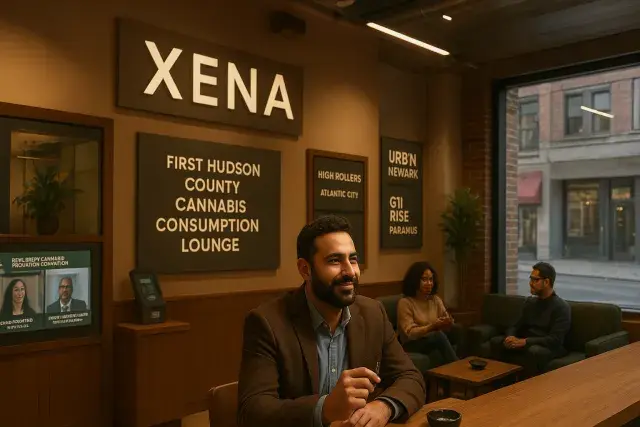

The New Jersey Cannabis Regulatory Commission voted 4-0 at a special meeting to approve Xena dispensary in Jersey City's McGinley Square as a licensed cannabis consumption lounge - making it the first such operation in Hudson County and the fifth approved in the state. The approval came after both the Jersey City Cannabis Consumption Board and City Council had already signed off at the local level, clearing the dual-approval path that New Jersey's regulatory framework requires before a retailer can seek state-level authorization to operate a lounge.
Acting Executive Director Christopher Riggs told the commission the dispensary had been operating for some time and that staff was recommending approval without reservation. Xena joins a short but growing list: Urb'n in Newark holds the North Jersey distinction of being first, while High Rollers and Sunnytien in Atlantic City and Gynsyng in Merchantville round out the state's consumption lounge count. Owner Haytham Elgawly - a local Egyptian American entrepreneur who transitioned from the legacy market and previously ran a clothing store in the same location - represents the kind of operator profile New Jersey's social equity framework was nominally designed to support. The operational complexity of running a compliant consumption lounge, from ventilation and staff training to age verification and on-site consumption tracking, is meaningfully different from standard retail dispensary operations; operators in other regulated markets investing in tools like dispensary pos software alaska have learned that lounge environments often require workflow adaptations beyond a basic point-of-sale setup.
The same meeting handled a substantial volume of licensing business. Two companies - GreenCoast Dispensary LLC and LT Retail LLC - received 4-0 approval to convert from conditional to annual licenses, the step required before a retailer can open legally for sales. Four additional applicants pursued annual licensure without going through the conditional license process: Blue Harvest LLC and Emsky NJ as manufacturer applicants, OT Manufacturing LLC as a standard manufacturer, and Friendly Greens LLC on the retail side. The commission also approved a wave of ownership changes across ten companies, including Cookies Harrison LLC, Everest Dispensary LLC, Loud Labs NJ LLC, and several others - routine but consequential transactions that require regulatory sign-off to keep license records accurate under New Jersey's compliance requirements. Commissioner Amelia Mapp recused herself from the Canna Verde Dispensary vote citing an ongoing professional relationship; that application passed 3-0.
GTI's Paramus Location Cleared for Adult-Use Sales
The commission also approved GTI Rise in Paramus - a Bergen County Alternative Treatment Center operated by multi-state operator Green Thumb Industries - to begin adult-use cannabis sales. Riggs confirmed the facility holds sufficient product inventory to maintain medical cannabis service alongside adult-use operations. The approval follows a recently enacted bill, signed by Governor Mikie Sherrill, allowing existing medical dispensaries to convert to adult-use sales without requiring separate municipal approval. That's a notable legislative shift. Home rule has been one of the most persistent friction points in New Jersey's adult-use rollout, giving individual municipalities broad authority to opt out of cannabis retail - and the industry has made little secret of its frustration with that structure. The new law carves out a limited exception for licensed medical operators, though it applies only to a fraction of the state's dispensary footprint.
A Microbusiness Converts - and the Commission Takes Notice
Perhaps the most closely watched action of the meeting, from a market-structure standpoint, was Happy Leaf LLC's approval to convert from a microbusiness license to a standard cannabis business license. The Somerdale dispensary has been operational for a year. Commission Chair Harris Laufer didn't hide his enthusiasm: "We love to see microbusinesses converting to standard businesses. This is exactly how the marketplace was designed."
Fair enough - but the microbusiness pathway hasn't worked as smoothly as designed for most operators who've tried it. The license tier was intended to lower barriers for entrepreneurs with limited capital, creating an on-ramp into the licensed market. In practice, though, many municipalities and third-party consultants charged microbusiness applicants rates comparable to what multi-state operators pay, eroding the cost advantage the license type was supposed to provide. Happy Leaf's conversion is worth celebrating. It's also worth acknowledging that it represents the exception more than the rule, and that the structural obstacles facing small-scale cannabis entrepreneurs in New Jersey have not disappeared simply because the pathway exists on paper.
What This Meeting Signals for New Jersey's Retail Tier
The volume and variety of actions at a single special meeting - lounge approvals, license conversions, ownership changes, MSO adult-use authorizations - reflects where New Jersey sits in its regulated market maturation. The early licensing sprint is over. What remains is the harder work of stabilizing operations, thinning the gap between conditional and annual licensure, and building a retail tier that includes operators of different sizes and backgrounds. Consumption lounges represent a distinct revenue and compliance category that most dispensary operators haven't had to think through yet. As more municipalities open that door, the operational and regulatory demands of running a lounge - separate from a standard dispensary floor - will require more deliberate attention from both license holders and the commission itself.