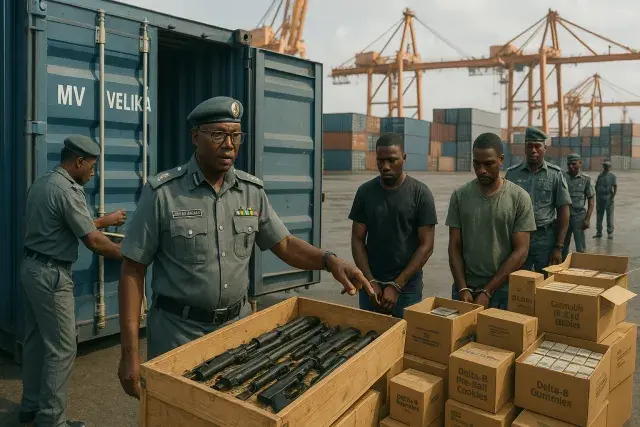
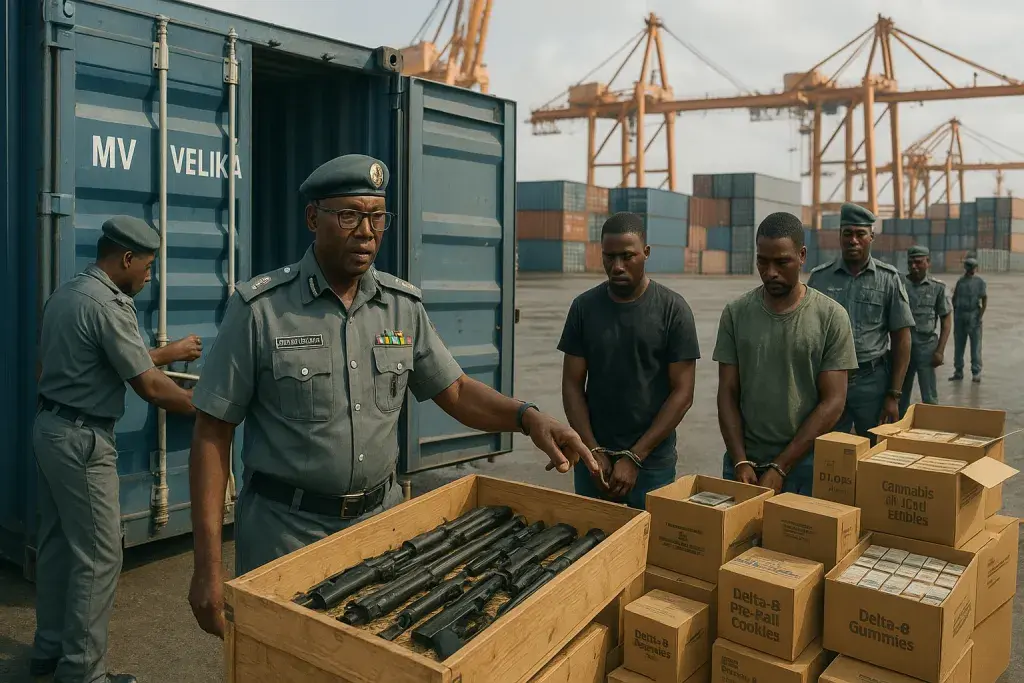
The Nigeria Customs Service has disrupted a smuggling attempt at Tincan Island Port that combined disassembled firearm components with cannabis-infused consumer goods, a pairing that speaks to how organized trafficking networks now blend contraband categories inside a single supply chain. Comptroller General Adewale Adeniyi announced the seizures on Thursday, 6 August 2026, describing a container flagged for enhanced monitoring after arriving aboard MV VELIKA on 8 July 2026. Inside were crates of knocked-down parts preliminarily identified as JoJeff pump-action rifles, numbering more than 140 units, concealed within what otherwise looked like routine commercial cargo.
What's striking here is the logistics discipline behind the operation. Smugglers didn't just stash weapons parts in a container and hope for the best; they built a shipment designed to pass casual inspection, relying on volume and misdirection rather than outright concealment tricks. That's a pattern regulators in other jurisdictions have flagged too, particularly as legal cannabis markets mature and operators lean on traceability tools to keep licensed inventory separate from anything resembling these gray-market shipments. In regulated U.S. markets, for instance, dispensaries and distributors increasingly depend on systems like California seed-to-sale dispensary software to document every gram from cultivation to point of sale, precisely the kind of chain-of-custody record that a container full of unlabeled, undeclared cannabis-infused cookies and gummies never has.
In a separate but related action, Customs officers intercepted two 40-foot containers carrying cannabis-infused pre-roll cookies, gummies and similar edibles, tucked in among used vehicles, generators and batteries. The haul included 109 cartons of Delta-8 pre-roll cookies, 125 cartons of Delta-8 gummies and 73 cartons of cannabis-infused cookies, with a combined street value placed at ₦373,802,640. None of it carried the documentation, batch testing, or compliant packaging that licensed markets require. That absence matters. In jurisdictions with functioning adult-use or medical cannabis programs, products like these would need a certificate of analysis confirming potency and contaminant screening before ever reaching a shelf. Here, there was no shelf to begin with - just a shipping manifest built to obscure what was actually inside.
Why Mixed-Contraband Shipments Signal Bigger Risk
Pairing firearm parts with cannabis-infused products in the same operation isn't coincidental. Networks moving one category of contraband often have the infrastructure - false-bottom containers, corrupted paperwork, complicit intermediaries - to move another. For compliance professionals watching global cannabis trade develop, this is a reminder that product safety and border security are not separate conversations. Unregulated THC products entering a market with no lab oversight create consumer exposure risks that mirror, in miniature, the same enforcement gaps that let weapons parts slip through. Adeniyi pointed to the Service's intelligence-driven risk management system and its profiling tools as the reason this shipment didn't clear undetected, crediting collaboration with other security agencies as a multiplier on that capability.
Election-Season Enforcement Pressure
The CGC's warning about the coming election cycle deserves attention beyond the immediate seizure. Adeniyi said criminal networks typically test border and port defenses harder during politically sensitive periods, and he pledged intensified screening at ports, airports and land borders. He also addressed internal risk directly, stating that Customs would not tolerate personnel who use their positions to facilitate imports "that will threaten our peace and security." For any business moving legitimate goods through Nigerian ports, that signals more scrutiny ahead, not less - longer processing windows, tighter documentation checks, and less patience for cargo manifests that don't add up.
What This Means for Legitimate Trade
Two suspects were arrested in connection with the firearms shipment; a third remains at large. Investigations continue, and Adeniyi has asked the public to supply credible intelligence to support ongoing enforcement. For import-export operators, freight forwarders and anyone touching consumer goods with cannabis-derived ingredients, the lesson isn't subtle: mislabeled or undeclared cargo, especially anything resembling a controlled substance, now sits squarely in the path of a risk-profiling system built to catch exactly this kind of concealment. Legitimate trade isn't the target. But the margin for sloppy paperwork just got thinner.