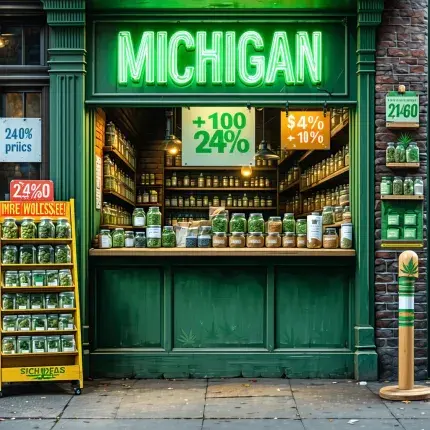

Michigan's marijuana industry has spent years drowning in its own supply - too much flower, too many license holders, and wholesale prices that keep sliding toward the floor. But a demographic hiding in plain sight may offer a way out. Baby Boomers, according to federal survey data and cannabis market research, are consuming cannabis at record rates and could already represent a market worth roughly half a billion dollars a year across Michigan and Ohio combined.
That estimate comes from applying national generational spending patterns - Baby Boomers accounted for about 12.6 percent of tracked U.S. cannabis purchases over a recent 12-month period, according to data attributed to Headset - against actual state sales totals. Michigan's approximately $3.17 billion in 2025 cannabis sales, run through that same math, points to a Boomer market approaching $400 million annually in that state alone. Neither Michigan nor Ohio publishes sales broken out by customer age, so these are estimates, not official figures. Still, the scale is hard to ignore, particularly as operators explore new distribution channels - including platforms like the cannabis delivery software new jersey market has adopted to reach customers who may be less inclined to walk into a storefront.
A Different Kind of Customer Requires a Different Retail Model
Here's the catch: selling to a 65-year-old customer isn't the same as selling to a 25-year-old one. University of Michigan polling on older consumers found the top reasons for use were relaxation, sleep support, enjoyment of effects, and pain relief - not chasing the highest-THC flower on the shelf. That points toward lower-dose edibles, tinctures, topicals, and balanced THC-CBD formulations rather than the concentrate-heavy SKU mix many dispensaries built their budroom around during the high-potency arms race of the past several years.
It also points toward something dispensaries can't put on a shelf: staff time. A consumer returning to cannabis after three or four decades away is walking into a completely unfamiliar retail environment - vape cartridges, live resin, nano-emulsified beverages, compliant packaging with unfamiliar dosing charts. Budtenders trained to move volume may need retraining to explain products patiently, without drifting into medical claims that would run afoul of state advertising rules. For operators, that's a labor-cost question as much as a marketing one.
What This Means for Oversupplied Markets Like Michigan
Michigan's price collapse - ounces of flower dropping below $60 in early 2026 - has made the state one of the cheapest adult-use markets in the country, even as the new 24 percent wholesale tax squeezes margins further. Consolidation and production cuts have dominated the industry's response so far. Growing the customer base has gotten less attention, despite evidence that a meaningful slice of the population, older Michiganders in particular, already consumes cannabis at rates above the national average.
Ohio's newer adult-use market, which crossed $836 million in 2025 sales, faces a different challenge: building demand from a younger base while the Boomer segment is still forming. That gives Ohio operators a chance to build service-oriented relationships with older customers early, before the segment gets crowded with competing marketing.
Compliance and Safety Cannot Be an Afterthought
None of this works if retailers treat older customers as an easy upsell. Today's cannabis products carry far higher THC concentrations than what many Boomers remember from decades earlier - 83 percent of Michigan adults 50 and older said as much in University of Michigan polling. Older consumers are also more likely to take prescription medications, raising legitimate concerns about interactions that dispensary staff are not licensed to advise on.
- Age verification and ID checks remain non-negotiable at point of sale, regardless of customer demographic.
- Staff should direct health-related questions to physicians rather than making therapeutic claims about sleep, pain, or mood products.
- Lab-tested COAs and clear, compliant labeling matter more, not less, when serving consumers unfamiliar with modern potency levels.
- Impaired-driving risk applies across age groups; roughly one in five older Michigan consumers reported driving within two hours of use in the past year.
The opportunity is real, but it's a retail and education problem before it's a marketing one. Dispensaries that treat older consumers as customers who need guidance - not just another line on a wholesale menu - stand a better chance of building lasting demand in two states that badly need it.