Planet 13 Holdings posted a narrower net loss and better gross margins for the second quarter of 2026, even as revenue fell nearly 15% year over year on the exit from California and continued price compression in its core Nevada and Florida markets. The results land at an unusual moment for the multi-state operator: with a definitive merger agreement with Vireo Growth already signed, this quarter's numbers read less like a standalone growth story and more like a final report card before the company folds into a larger combined entity.
Margin Gains Mask a Shrinking Top Line
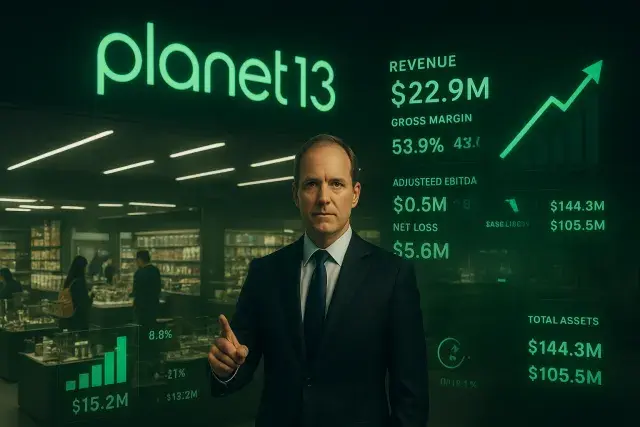
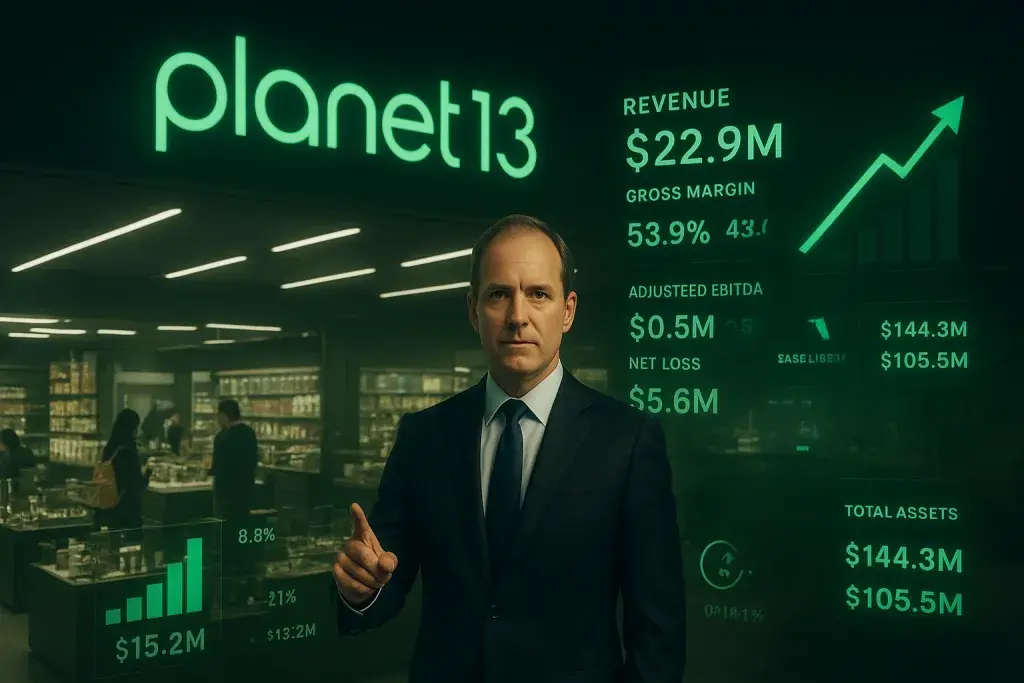
Revenue came in at $22.9 million, down from $26.9 million a year earlier. That's not a small drop. But the more instructive number sits a few lines down: gross margin climbed to 53.9% from 43.4%, driven partly by the California wind-down and partly by a $1.0 million reduction in an inventory reserve tied to Florida distillate. Strip out that reserve adjustment and margin still lands at 49.5%, a meaningful improvement. In practice, this is what a deliberate retreat from a low-margin, overcrowded market looks like on paper - California's wholesale pricing had been grinding operators down for years, and exiting it, however painful in the short term, freed up capital and management attention for markets with better unit economics.
Sequentially, the story looks more encouraging: revenue grew 8.4% quarter over quarter, and Florida sales rose 17.1% over Q1. For a company that has spent recent quarters stabilizing its Florida footprint - including new OMMU approval for a BHO extraction facility and continued retail expansion with an upcoming Sarasota store - that sequential improvement matters more to investors than the year-over-year comparison, which is distorted by the California exit.
Cost Discipline Shows Up in the EBITDA Line
Total expenses fell 17.7% to $15.2 million, and the adjusted EBITDA loss narrowed to $0.5 million from $2.4 million a year prior. That's a real operational shift, not just an accounting artifact. Company-wide cost-cutting and procurement initiatives appear to be doing what they were designed to do: shrinking the gap between gross profit and the overhead required to run a vertically integrated cultivation, production, and retail operation across three states. Net loss still totaled $5.6 million, down from $13.3 million, which tells you the company is bleeding less cash, not that it has reached sustained profitability.
The balance sheet moved modestly in the other direction. Total assets slipped to $144.3 million from $152.3 million at year-end 2025, while total liabilities rose to $105.5 million from $101.2 million. Cash and restricted cash ticked up slightly to $16.5 million. None of these shifts are dramatic, but they underline why the Vireo merger matters: a smaller, standalone MSO with compressed margins in Nevada and Florida has limited room to absorb further price declines without either scale or fresh capital.
What the Vireo Merger Changes for Stakeholders
Co-CEO Bob Groesbeck framed the deal plainly - the market rewards scale, purchasing power, distribution breadth, and balance sheet strength, and a combined entity with Vireo gives Planet 13 shareholders exposure to all four. That's a candid admission for a company that built its brand on a flagship Las Vegas superstore model; the standalone approach that made Planet 13 distinctive is not, on its own, enough to compete against operators with broader multistate footprints and deeper wholesale relationships.
For dispensary operators and suppliers watching from outside, the filing is a reminder of what price compression does to even well-run vertically integrated companies. Nevada and Florida remain competitive, mature-ish markets where wholesale pricing keeps sliding as cultivation capacity outpaces retail demand growth. Cost controls and inventory reserve management can buy time and improve margin ratios, but they don't reverse a shrinking top line on their own. Because of the pending merger, Planet 13 skipped its usual earnings call this quarter - a small but telling detail suggesting management's attention has shifted toward closing the transaction rather than managing quarterly investor relations. For employees, patients, and customers across Planet 13's Nevada, Illinois, and Florida operations, the practical questions now center on integration timing and how store-level operations, from POS systems to compliance logs, transition once the deal closes.