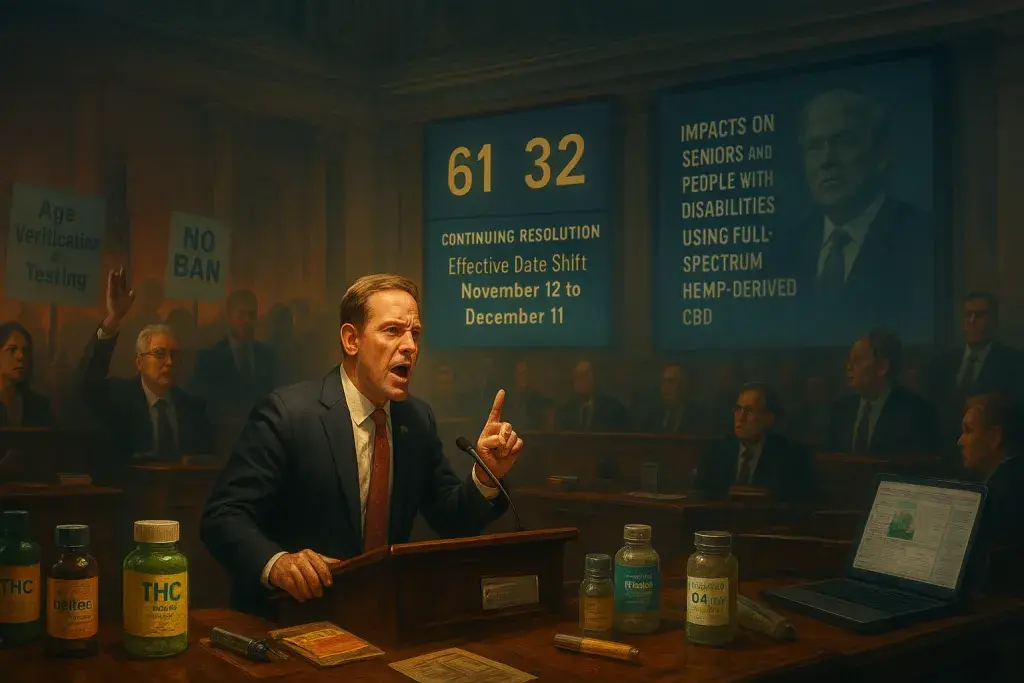
A Senate effort to strip a 30-day delay out of the federal government's looming hemp restrictions failed on Aug. 8, when senators voted 61-32 to table an amendment from Sen. Ted Budd, R-NC. The vote keeps intact a provision in the continuing resolution that pushes the effective date of sweeping new hemp THC limits from Nov. 12 to Dec. 11 - a month operators, retailers, and regulators will now spend scrambling to prepare for whichever version of the rule ultimately lands.
For dispensary operators and hemp retailers watching this fight from the sidelines, the underlying mechanics matter more than the floor drama. The 2025 law rewrites the federal definition of hemp to account for total THC, not just delta-9, and it caps finished hemp-derived cannabinoid products at 0.4 milligrams of combined total THC and related cannabinoids per container. That threshold would functionally eliminate most THC beverages, gummies, vapes, delta-8 products, and THCA flower currently sold through convenience stores, smoke shops, and unlicensed retail channels nationwide. Operators already navigating traceability requirements in regulated markets know the drill: inventory reconciliation, batch-level compliance logs, and point-of-sale systems built to flag noncompliant SKUs before they ever reach a shelf. In Utah, for instance, licensed retailers running Metrc-compliant POS for Utah have had to build that kind of discipline into daily operations for years - a level of rigor the largely unregulated hemp market has mostly avoided. Metrc-compliant POS for Utah
Why the 30-Day Delay Matters More Than It Looks
A one-month delay sounds like a rounding error. In practice, though, it's the difference between an industry bracing for a hard stop and one hoping Congress writes something new before the deadline arrives. That's precisely what the 105-organization coalition - including the US Hemp Roundtable, the National Association of Convenience Stores, and several North Carolina hemp groups - argued in their Aug. 6 letter to Senate leadership. Their position: use the extra weeks to pass real regulation - age verification, testing requirements, synthetic cannabinoid import restrictions, good manufacturing practices - rather than let a blunt THC threshold wipe out product categories overnight.
Budd wasn't buying it. His floor argument leaned hard on consumer safety, citing North Carolina emergency department data showing a steep rise in cannabis-related visits among minors and pointing to packaging that mimics familiar snack and candy brands. Whether or not lawmakers ultimately side with his read of the market, the packaging issue itself is not in dispute - it's a documented friction point in states from coast to coast, and it's exactly the kind of consumer-protection concern that regulators in licensed cannabis markets have spent years designing compliant packaging rules to prevent.
A Split That Crossed Party Lines - and the White House
The 32 votes against tabling Budd's amendment included 21 Republicans and 11 Democrats, a coalition that doesn't map neatly onto typical partisan lines on cannabis policy. More notably, Budd found himself at odds with the Trump administration, which backed the delay while CMS Administrator Dr. Mehmet Oz separately warned that letting the restrictions take effect on schedule could disrupt expanded access to full-spectrum hemp-derived CBD for seniors and people with disabilities. That tension - public-safety urgency versus preserving a regulatory pathway for medical-adjacent hemp products - is likely to resurface as Congress works toward a more permanent framework.
North Carolina's Parallel Fight Isn't Over Either
Back home, Budd's push mirrors an unresolved state-level standoff. House Bill 328 would import the same 0.4-milligram threshold directly into North Carolina law, meaning the state ban could survive even if Congress delays or rewrites the federal rule. The Senate approved the conference report 37-6 back on July 2, but the House has repeatedly declined to act, leaving the bill parked in Rules Committee. House Speaker Destin Hall says there's broad agreement the current unregulated market can't continue - just not on what replaces it. For operators, wholesalers, and landlords tied to hemp retail leases, that ambiguity is the real business risk: two deadlines, two governments, and no settled answer on which threshold, if either, actually sticks.