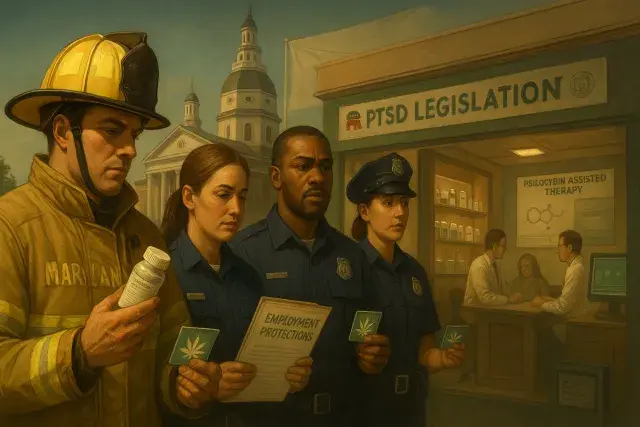
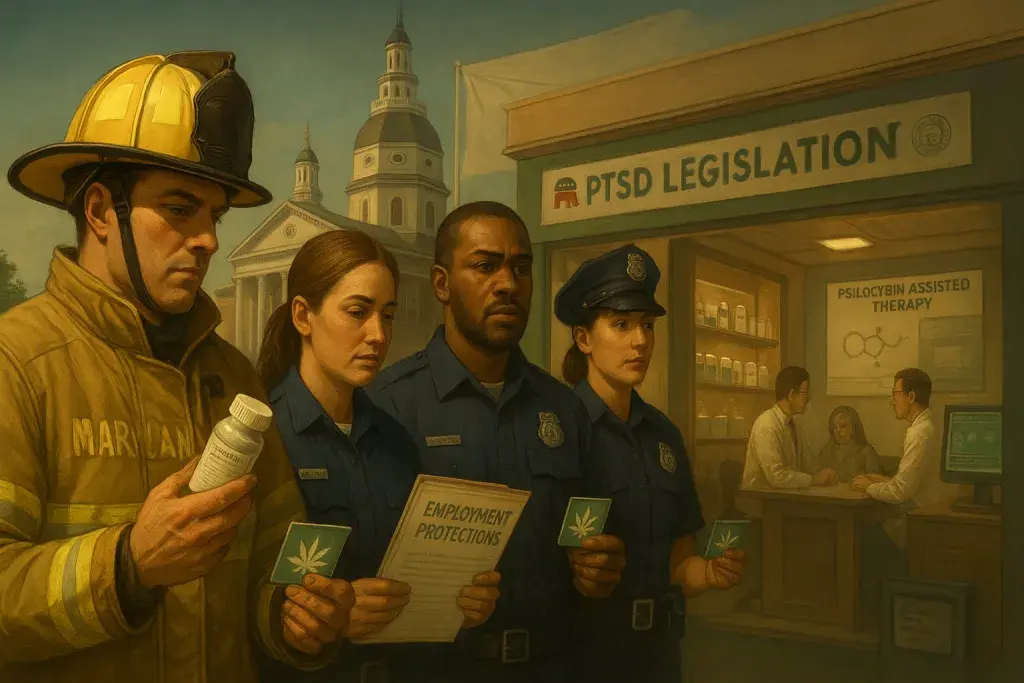
A quiet but accelerating policy shift is playing out across multiple state legislatures this year: first responders dealing with post-traumatic stress are gaining access to a wider range of treatment options, including medical cannabis protections and emerging psychedelic-assisted therapies. For the licensed cannabis industry, that shift carries direct operational and compliance implications - particularly for dispensaries operating in medical markets where first-responder patients represent a regulated, employment-sensitive customer segment.
Maryland's new law - effective this October - is the clearest example of where cannabis regulation and occupational policy are now intersecting. The statute protects firefighters, emergency medical technicians, paramedics, and other rescue workers from employment discrimination based on lawful off-duty use of medical marijuana, provided the employee is not impaired while on duty. The protection applies specifically to registered medical cannabis patients who test positive for cannabis metabolites - a distinction that matters because metabolites can linger long after any psychoactive effect has cleared. For dispensary operators serving this patient population, that distinction shapes how staff explain program requirements, how purchase records feed into compliance documentation, and how a point-of-sale built for cannabis retail can accurately document patient status, purchase history, and applicable regulatory protections at the transaction level. Getting that patient record right isn't optional - it's what separates a defensible compliance log from a liability exposure.
Ohio took a structurally different route. Republican Gov. Mike DeWine signed legislation this year creating a Post-Traumatic Stress Injury Commission charged with reviewing applications from eligible first responders and helping cover treatment costs. The mechanism is administrative rather than product-specific - it doesn't open any new cannabis access pathway directly - but it signals that state governments with traditionally conservative postures on substance policy are willing to treat PTSD among first responders as a distinct, fundable public health problem. That political framing matters for the cannabis industry. When Republican-led states start building institutional infrastructure around first-responder mental health, the policy door for medical cannabis as an eligible treatment option tends to widen, even if incrementally.
Psychedelic Research Adds a New Layer of Complexity
Connecticut and Missouri are testing the outer edge of this trend. Connecticut expanded a Yale University pilot program studying psilocybin-assisted therapy - previously limited to veterans, retired first responders, and frontline health care workers - so that any state resident 18 or older who meets clinical eligibility criteria can participate. Missouri lawmakers advanced a bill this session that would allow veterans and first responders in approved research studies to access psilocybin and ibogaine under medical supervision for PTSD and other mental health conditions; the legislature adjourned in May before the bill reached the governor's desk.
Psilocybin and ibogaine are not cannabis, and the regulatory frameworks surrounding them are entirely separate. But the trajectory matters to the licensed cannabis industry for a practical reason: states actively creating legal research pathways for psychedelic-assisted therapy are demonstrating a broader willingness to move outside conventional treatment models. In those same states, the political argument for expanding or protecting medical cannabis access for first responders tends to face less institutional resistance. The two policy tracks run in parallel, not in tandem - but operators and compliance teams in multi-state markets should be watching both.
What Dispensary Operators in Medical Markets Actually Need to Understand
The Maryland employment protection law is the most operationally relevant development for licensed retailers right now. Here's the thing: the law doesn't change who can purchase or possess medical cannabis - it changes the employment risk calculation for registered patients who are first responders. That may seem like an HR matter, not a dispensary matter. In practice, though, it affects patient confidence in the medical program, which affects medical card registration rates, which affects dispensary revenue in markets where medical and adult-use sales are taxed differently.
Medical cannabis transactions typically carry lower excise tax rates than adult-use sales in states that operate dual-track licensing. If employment protections encourage more first responders to register as medical patients rather than purchasing recreationally - where protections may not apply - dispensaries in dual-track states may see a corresponding shift in their medical-to-recreational sales ratio. That shift has real tax implications. It also affects inventory allocation, wholesale purchasing decisions, and product mix - particularly for operators who stock medical-only formulations or dosage formats distinct from their adult-use SKU lineup.
Compliance teams should also be aware that "not impaired while on duty" is a legal standard, not a scientific one that cannabis testing currently resolves cleanly. Metabolite presence in a drug screen does not measure real-time impairment. Dispensaries cannot and should not make representations to patients about whether a specific product or consumption method will or will not trigger a positive test. That boundary matters - staff training should reflect it clearly, and it should never appear in marketing language or patient-facing communications.
The Broader Regulatory Trend Worth Tracking
Taken together, these state-level actions in 2024 and 2025 represent something worth noting without overstating: the political coalition supporting expanded mental health options for first responders is genuinely bipartisan. Ohio's Republican governor signing PTSD commission legislation and Maryland's employment protection law moving through a Democratic-controlled legislature in the same year reflects a point of policy convergence that doesn't show up often in cannabis regulation.
For the licensed cannabis industry, bipartisan support for medical cannabis as a legitimate treatment tool - even implicitly, through employment protection statutes - reduces the political risk premium that has historically made medical program expansion slow and unpredictable. It doesn't eliminate regulatory complexity or 280E exposure at the federal level. It doesn't resolve the banking access problem that still constrains most cannabis retailers. But it does shift the baseline political environment in which medical cannabis licensing and program expansion debates take place.
Operators building long-term patient acquisition strategy in medical markets should be paying attention to how first-responder access laws evolve in their states. The patient population is real, the policy momentum is real, and the compliance requirements that flow from it are specific. Staying ahead of those requirements - not scrambling to catch up after a law takes effect - is the operational posture that separates well-run dispensaries from the ones reading guidance after the deadline has passed.