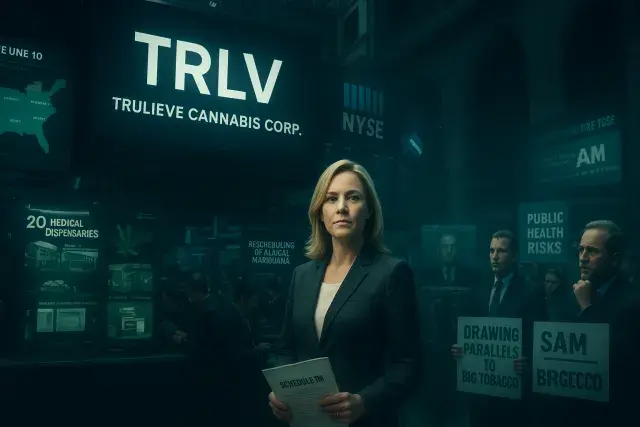
On June 10, Trulieve Cannabis Corp will begin trading on the New York Stock Exchange under the ticker "TRLV" - the first U.S. marijuana company to list on a major American exchange. The milestone follows a federal rescheduling of medical marijuana to Schedule III and a deliberate corporate restructuring that repositioned Trulieve as a strictly medical operator. Whether this is the beginning of cannabis finance maturing or a flashpoint in a still-unresolved public debate depends heavily on who you ask.
The path here was not a straight line. Trulieve restructured its operations to separate its medical and adult-use activities, focusing solely on state-licensed medical marijuana facilities - 206 dispensaries supported by 3.5 million square feet of DEA-registered production capacity across Florida, Pennsylvania, West Virginia, and other key states. That DEA registration is the linchpin. Acting Attorney General Todd Blanche finalized the Schedule III reclassification in April 2026, following President Trump's December 2025 executive order directing the rescheduling. DEA registration cleared the exchange listing barrier that had blocked cannabis companies from major U.S. markets for years. For operators in emerging markets - think New York, where compliance infrastructure like a cannabis dispensary pos system new york operators depend on is still being stress-tested - this federal shift signals that the regulatory floor is moving, even if the ceiling remains uncertain.
What this actually unlocks for Trulieve, at the operational level, is significant. The 280E tax restriction - which denied cannabis businesses standard federal tax deductions because marijuana remained a Schedule I controlled substance - has been one of the industry's most punishing financial constraints. Rescheduling to Schedule III removes that burden for state-licensed medical operators, improving cash flow in ways that directly affect everything from payroll structure to capital reinvestment in dispensary buildouts. Broader investor access through a major exchange also means a deeper shareholder base, greater institutional visibility, and a stronger balance sheet posture heading into potential expansion markets like Georgia and Texas.
CEO Kim Rivers and the Advocacy Behind the Uplisting
This didn't happen in a vacuum. Reports credit Trulieve CEO Kim Rivers with meaningful influence on the rescheduling decision through sustained advocacy, lobbying, and direct engagement - work that predates the formal executive order by years. That kind of regulatory engagement is standard practice in mature regulated industries; alcohol distributors, pharmaceutical manufacturers, and tobacco companies all maintain Washington relationships that shape policy. What's notable here is the timeline: a multi-state operator's executive reportedly helped move federal drug scheduling. That's a different category of industry influence than a state cannabis association filing public comments.
Jason Vedadi, a cannabis investor, framed the trade thesis bluntly in a post on June 5: the real play was never full federal legalization. It was rescheduling unlocking DEA registration, DEA registration clearing the exchange listing, and the exchange listing doing what exchanges do - attract capital and legitimize asset classes. That logic held. The crowd betting on outright federal legalization as the prerequisite missed the more pragmatic route the industry actually took.
The Opposition Is Organized and Not Going Away
Smart Approaches to Marijuana - SAM - was fast and direct in its response. CEO Kevin Sabet, a former White House drug policy advisor who served under three administrations, called the NYSE listing "a dark and terrible day for public health." SAM's statement draws a direct line between Wall Street investment and the promotion of high-potency, addictive products, invoking the history of Big Tobacco as a cautionary parallel. The organization says it is exploring legal options to challenge the listing.
Fair enough to take that seriously. SAM is not a fringe group. It has shaped federal and state cannabis policy debates for years, and the Big Tobacco comparison, whatever its limits, resonates with a real concern: that capital markets, once given a stake in an industry's growth, create structural pressure to expand consumption regardless of public health outcomes. That pressure is real in alcohol. It's real in pharmaceuticals. There's no particular reason to assume cannabis is immune to it.
The thing is, the policy argument about whether cannabis should be accessible at all is a different question from the operational and regulatory question of how a licensed, DEA-registered medical cannabis business behaves in a compliance-governed market. Trulieve, post-restructuring, operates medical dispensaries subject to state licensing requirements, product testing mandates, age restrictions, compliant packaging rules, seed-to-sale tracking, and METRC reporting obligations. None of that disappears because the company now trades on the NYSE.
What the Listing Means for the Broader Cannabis Business Sector
For multi-state operators watching closely, the Trulieve listing rewrites the calculus on capital strategy. Exchange-listed status means access to a different class of institutional investor - one that couldn't previously hold cannabis equity through standard compliance channels. It also changes how lenders, landlords, payment processors, and technology vendors assess counterparty risk when dealing with licensed cannabis businesses. A company that trades on the NYSE carries a different credit profile than one that trades over the counter.
That has downstream effects across the supply chain. Wholesale pricing negotiations, software licensing agreements, real estate leases, and banking relationships are all influenced by the perceived stability and legitimacy of the operator on the other side of the table. For smaller multi-state operators and single-state licensees, Trulieve's uplisting doesn't directly change their situation - but it establishes a reference point that will shape how the broader industry is perceived by capital markets going forward.
The public health debate will continue. SAM's opposition is principled, its legal challenge may or may not find traction, and the question of whether Schedule III reclassification normalizes use in ways that carry social costs is one regulators, researchers, and policymakers will be arguing about for years. What happened on June 10 is a business event with real policy architecture behind it. The two conversations - public health risk and regulated market structure - are both legitimate. The industry would be unwise to treat them as mutually exclusive.