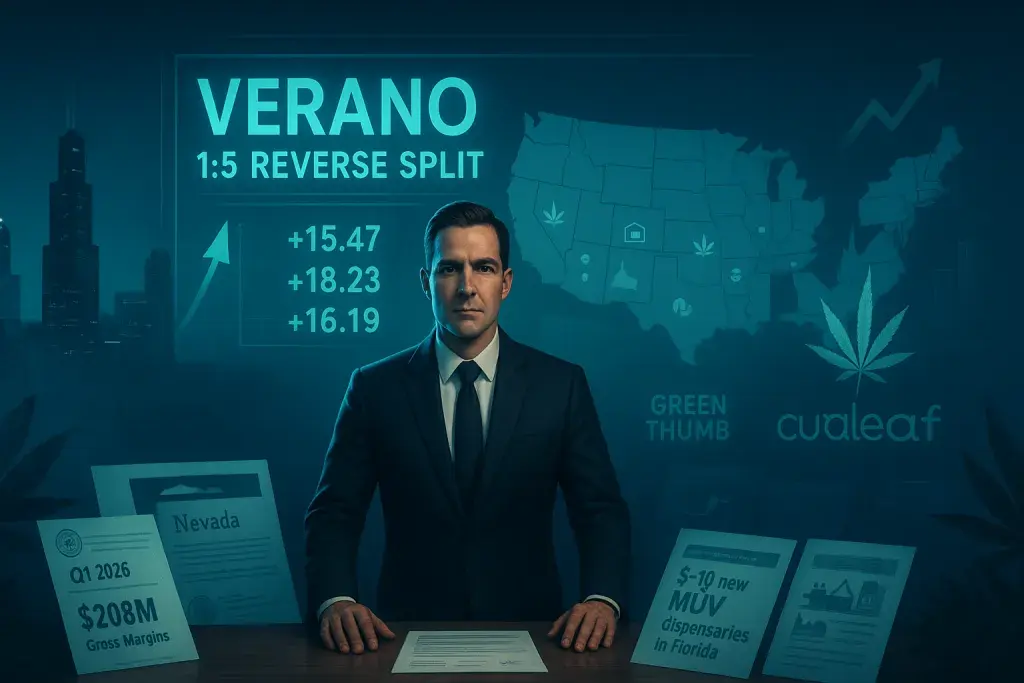
Verano Holdings has completed a 1-for-5 reverse stock split, a move the Chicago-based multi-state operator frames as part of a deliberate effort to position itself for uplisting to a major U.S. stock exchange. The split consolidates shares and raises the per-share trading price - a threshold requirement for the New York Stock Exchange and Nasdaq - and follows Verano's redomestication from British Columbia to Nevada last year. Taken together, these moves signal where management believes the cannabis capital markets story is heading, even if the timeline remains uncertain.
The strategic logic here is worth unpacking for operators and investors alike. Currently, institutional money largely sits on the sideline: fund mandates and exchange rules restrict participation in cannabis companies trading on over-the-counter markets or Canadian exchanges, compressing valuations and limiting liquidity. An uplisting would widen the investor pool considerably. That same dynamic plays out at the operational level - Verano's retail footprint spans multiple states, and in markets such as Maryland, where dispensary operators are managing tight compliance requirements and investing in infrastructure like a dispensary pos system maryland to meet traceability and reporting mandates, access to capital at a lower cost of equity would be materially meaningful. Better-capitalized MSOs can fund store buildouts, production capacity, and technology upgrades on more favorable terms than operators who remain locked out of mainstream institutional capital.
None of this is guaranteed, of course. Uplisting requires sustained compliance with exchange financial standards - not just a higher share price, but minimum equity thresholds, governance requirements, and consistent financial reporting. Verano's first-quarter 2026 results show a company holding steady rather than accelerating: revenues came in at $208 million, down roughly 1% year over year but up 1% sequentially. Gross margin held at 47.5%, which is a respectable number for a vertically integrated MSO in the current environment, though SG&A crept up about 1.5% to nearly $86 million, driven in part by new store opening costs. Three new MÜV dispensaries opened during the quarter. Management expects to open five to ten additional locations in 2026, primarily in Florida.
Federal Reform Momentum Adds Context, Not Certainty
Verano's capital markets moves are unfolding against a federal backdrop that has shifted meaningfully, if incrementally. The Department of Justice's initiation of a rescheduling review - including the movement of certain state-licensed medical cannabis products toward Schedule III status - represents the most significant federal policy development in years. Rescheduling, if finalized, would not legalize cannabis federally. But it would remove the Section 280E tax burden that currently prevents cannabis businesses from deducting ordinary operating expenses, a structural disadvantage that has weighed heavily on MSO profitability for years. For a company carrying Verano's cost structure, 280E relief alone would be a meaningful earnings improvement.
The thing is, "reform momentum" has preceded actual reform by years in this industry. Operators who built business plans around imminent federal action have had to recalibrate repeatedly. What's different now is the formal regulatory process underway, which creates a more structured - if still slow - pathway than prior legislative efforts. Verano's management has acknowledged this directly, noting during its Q1 2026 earnings call that the company is actively preparing for regulatory changes rather than waiting passively. That posture matters. Being ready to move quickly when exchange listing windows open, or when 280E relief takes effect, requires structural preparation done well in advance.
Where Verano Stands Against Its Peer Set
MSO comparisons are instructive here. Green Thumb Industries, like Verano, operates almost exclusively in the U.S. market, making both companies similarly exposed to domestic regulatory risk and competitive pressure. Curaleaf has taken a different approach - its international operations, particularly in Europe, provide revenue diversification that neither Verano nor Green Thumb has pursued. Whether that international hedge proves valuable depends heavily on how European cannabis markets develop, which carries its own regulatory uncertainty.
What all three operators share is exposure to the same domestic pressure points: price compression from oversupply in maturing markets, promotional activity that erodes wholesale margins, and the persistent capital disadvantage of operating outside mainstream U.S. exchanges. Verano's wholesale segment is feeling that pressure explicitly - the company acknowledged continued headwinds there in its Q1 results. Retail has been the steadier performer, with Pennsylvania, Maryland, Arizona, Nevada, Florida, and West Virginia cited as growth contributors. That retail stability is meaningful; it suggests Verano's dispensary operations are absorbing competitive pressure better than its B2B wholesale business, at least for now.
What Operators and Investors Should Actually Watch
For dispensary operators and cannabis business professionals watching Verano's moves, the practical implications come down to a few questions. Can the company sustain its gross margin profile while absorbing new store costs and a competitive wholesale market? Does the reverse split actually advance an exchange listing, or does it remain contingent on federal regulatory progress that could take years? And how does management balance Florida expansion - a market that combines high consumer volume with significant competitive density - against the need to protect margins across its existing footprint?
Investors, meanwhile, should treat the capital markets positioning as optionality, not a near-term catalyst. The reverse split is a necessary administrative step, not evidence that an uplisting is imminent. The broader regulatory environment is improving directionally, but the pace of change in cannabis policy has consistently been slower than industry expectations. Verano's fundamentals - stable margins, measured expansion, and a clarified U.S. corporate structure - represent a reasonable foundation. Whether that foundation supports a meaningfully higher valuation depends on variables that are, at this point, still outside the company's direct control.