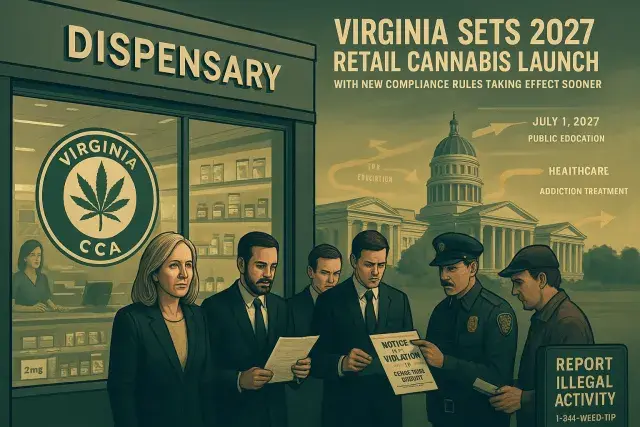
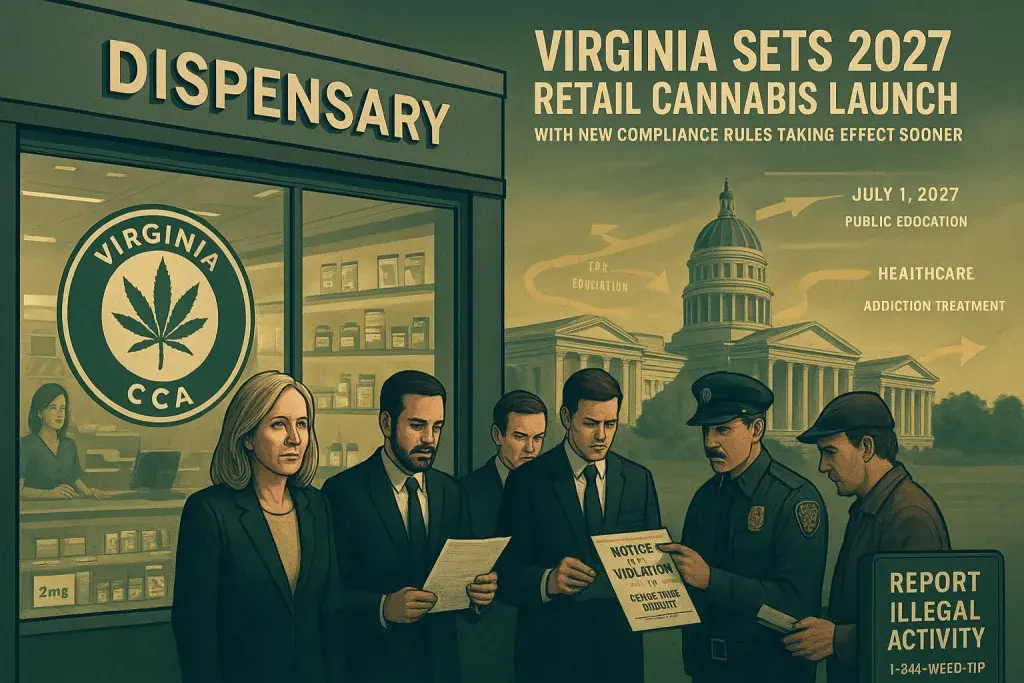
Virginia has finalized the regulatory framework for its adult-use cannabis retail market, with licensed dispensaries scheduled to open July 1, 2027 - but operators and hemp retailers will feel the first major compliance pressure well before that date. Following a budget compromise between Governor Abigail Spanberger and the state legislature, the Virginia Cannabis Control Authority (CCA) now holds a clear mandate, a defined timeline, and expanded enforcement authority to reshape what products can legally sit on shelves across the Commonwealth.
The practical implications for existing retailers are significant. Starting August 2026, oversight of all hemp-derived products shifts entirely from agriculture officials to the CCA - a jurisdictional change that rewrites who regulates, who enforces, and what compliance documentation businesses need to maintain. For any operator running a POS system loaded with hemp SKUs, that transition is a quiet inventory audit waiting to happen. Understanding what your product catalog actually contains - and whether it meets the incoming two-milligram THC-per-package threshold - is not an administrative afterthought; it's a near-term operational priority. If you're evaluating how your retail technology handles compliance-linked product data, see how it works before the August window arrives.
On August 15, 2026, the state closes the so-called "25:1 loophole." Under that prior standard, hemp products could exceed two milligrams of THC per package as long as they held a 25:1 CBD-to-THC ratio. That carveout is gone. Any product carrying more than two milligrams of total THC per package will no longer qualify as a legal hemp product in Virginia - full stop. For brands and wholesalers supplying hemp retailers, that is a formulation and labeling deadline, not just a policy note. Product batches that don't meet the new threshold will need to be pulled or reformulated before that date.
Enforcement Gets Real Teeth This Time
Senate Bill 543 gives the CCA authority to issue immediate notices of violation, levy civil penalties, and hand down cease-and-desist orders against unlicensed operators. That is a meaningful escalation from what was previously available. Regulators in early-stage cannabis markets often face a gap between the rules on paper and the tools available to enforce them - Virginia is explicitly closing that gap ahead of the 2027 retail launch.
The state is also building a public reporting infrastructure. Residents can flag suspected illegal commercial activity through an online portal or a dedicated toll-free hotline - 1-844-WEED-TIP. That kind of citizen-facing enforcement mechanism creates ambient compliance pressure for anyone operating outside the licensed system; it also signals that the CCA intends to use community input as an active part of its illicit market strategy, not just enforcement staff alone.
Licensed retailers will be required to display an official state-issued decal in their store windows. That requirement sounds minor, but in practice it functions as a visible compliance signal to both consumers and regulators - a low-cost mechanism that makes licensed businesses easy to distinguish from unlicensed ones at a glance.
Tax Revenue Earmarks and the Equity Framework
Future tax revenues from the 2027 retail market are legally earmarked for public education, health care initiatives, addiction treatment programs, and communities historically disproportionately affected by drug enforcement. That structure mirrors the social equity frameworks adopted in several other adult-use states and reflects the political commitments that helped move the compromise through the legislature. For operators, it's worth understanding that earmarked revenue structures can influence how aggressively regulators pursue licensing fees, excise tax rates, and market expansion - because the downstream funding commitments create pressure to generate consistent revenue from the regulated market.
Governor Spanberger had vetoed an earlier retail cannabis bill in May, citing concerns over public health, youth safety, implementation, cost, and effectiveness. The finalized framework represents a negotiated response to those concerns - one that builds in phased timelines, tighter product controls, and expanded enforcement rather than a single-step market launch.
Medical Access, Expungement, and What Else Changed
The regulatory update doesn't stop at retail. House Bill 391 and House Bill 75 expand medical cannabis access for terminally ill patients. Senate Bill 230 and House Bill 26 create pathways to expunge certain past marijuana-related records and modify prior sentences - changes that matter both as equity measures and as practical considerations for individuals navigating employment or licensing eligibility in the emerging market. House Bill 942 adds protections for parental rights around the legal use of authorized substances.
Existing hemp retailers will receive direct state communication about registration renewals as the CCA transition approaches. The message for operators across the board is straightforward: the August 2026 compliance deadlines are the real near-term pressure point, and the 2027 retail launch is the destination. The distance between those two dates is not much runway.