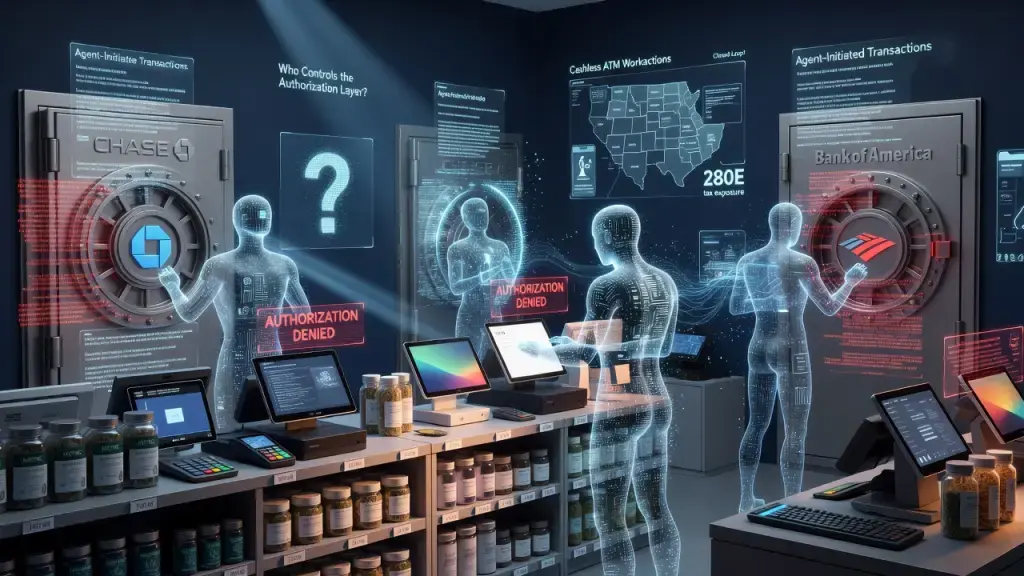
Seven financial and technology companies made a decision this fall that most cannabis operators haven't noticed yet, but should. Banks, payment networks, and software vendors have each staked out a different answer to a question that sounds abstract until it isn't: who actually authorizes an automated agent to spend money on a licensed business's behalf? For an industry already drowning in compliance logs, cashless workarounds, and 280E tax exposure, that question is about to land on budroom inventory systems and wholesale ordering platforms whether operators are ready or not.
Why This Matters for a Cash-Adjacent, Over-Regulated Industry
Cannabis retail runs on brittle payment infrastructure already. Federal illegality keeps most national card networks at arm's length, pushing dispensaries toward cashless ATM workarounds, closed-loop apps, and state-licensed payment processors that charge premium rates for the privilege of touching plant-touching commerce. Into that fragile stack, add the prospect of AI purchasing agents handling wholesale reorders, POS reconciliation, or vendor payments - and the question of who controls the authorization layer stops being theoretical. If a bank can impose a blanket block on agent-initiated transactions, as several major banks have signaled this quarter, a dispensary's automated inventory-replenishment tool could simply stop working, with no warning and no appeal built into the merchant agreement.
The Authorization Layer Is the New Compliance Chokepoint
Cannabis operators already understand chokepoints. METRC reporting, state track-and-trace mandates, and lab testing requirements all function as gates that someone else controls, and a missed submission or a failed COA can freeze a batch of product before it ever reaches a shelf. The emerging pattern in mainstream finance - authorization decided upstream, via contract clause, directory registration, or minted credential rather than at the moment of sale - should sound familiar. It's the same architecture as a compliance hold, just applied to payments instead of product. A dispensary relying on an automated purchasing tool for wholesale menus or tax remittance could find itself gated not by a regulator, but by whichever bank, processor, or software vendor owns the authorization artifact underneath that tool.
What's striking here is the lack of uniformity. Some institutions are choosing outright vetoes on agent-initiated transactions. Others are shifting liability onto the account holder through contract language, effectively saying: if you let an agent act, you own the consequences. Still others are building registration and scoring systems that grant provisional access rather than a blanket yes or no. For an industry that already juggles license caps, social-equity compliance requirements, and state-by-state inconsistency, a fourth layer of fragmented rules - this time from the financial side - is not a small operational detail.
What Operators, Processors, and Software Vendors Should Watch
Cannabis-specific point-of-sale and payment vendors will need to decide, probably sooner than they'd like, where they sit in this stack. Do they register as a recognized agent with a payment network, the way a logistics or finance vendor might register a purchasing bot with a directory? Do they build in a human-in-the-loop checkpoint for any automated reorder above a certain dollar threshold, mirroring the "human keys it" model some payment platforms have adopted? In practice, though, most multi-state operators and independent dispensaries are nowhere close to deploying purchasing agents at scale. The more immediate takeaway is about vendor due diligence: any software promising automated wholesale ordering, automated excise tax remittance, or automated vendor payments should be able to answer, in plain terms, who holds the authorization decision and what happens if that party changes the rules.
- Ask payment and POS vendors directly whether their systems rely on agent-based authorization, and if so, who controls that authorization.
- Build manual override procedures for any automated purchasing or payment tool, rather than assuming continuous uptime.
- Track contract language in banking and processor agreements for new clauses addressing AI-initiated transactions - these are changing quickly and without much public notice.
- Treat any automated agent touching compliant packaging orders, lab-tested inventory, or tax payments as a compliance surface, not just a convenience feature.
None of this means dispensaries need to fear a wave of rogue purchasing bots draining operating accounts. It means the ground underneath payment authorization is shifting, and an industry that has spent a decade learning to operate inside tightly gated compliance systems should recognize this pattern immediately - because it's the same one, wearing different paperwork.