
When drugs become as easy to order as takeout, the absence of any regulatory architecture is not just a policy gap - it is a public health emergency in slow motion. That is precisely what Pakistan is confronting now. A convergence of expanded mobile internet access, digital payment infrastructure, and sophisticated trafficking networks has pushed narcotics sales into online channels, with young people emerging as both the primary market and, in disturbing cases, as unwilling couriers recruited through false promises of easy money. The data, while methodologically imperfect, points toward a crisis that is accelerating.
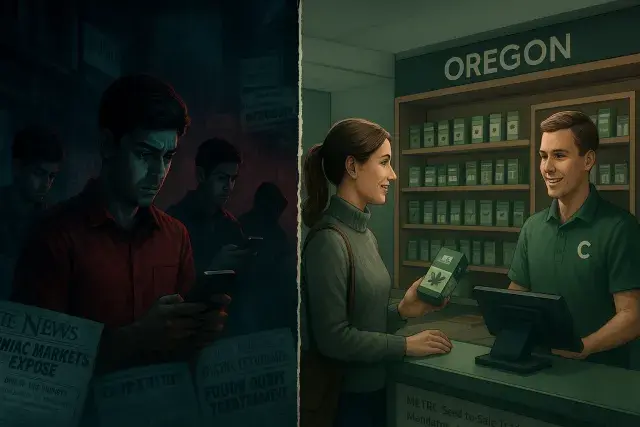
The contrast with licensed cannabis markets could not be sharper. In regulated adult-use states, operators invest heavily in age-gating, identity verification at the point of sale, seed-to-sale tracking, and transaction-level compliance logging precisely to prevent the kind of uncontrolled access now documented in Pakistan. A dispensary running point-of-sale for Oregon dispensaries, for example, operates inside a compliance framework that mandates METRC integration, age verification at every transaction, and strict prohibitions on delivery to anyone under 21 - requirements that exist because regulators understand, firsthand, how quickly unregulated access causes harm. The infrastructure of licensed retail is expensive and operationally demanding, but that burden exists for a reason.
Pakistan's situation illustrates what the absence of that infrastructure produces. According to reporting in The News International, citing the World Drug Report 2025, traffickers are using technology and global instability to introduce novel substances - many of them synthetic, more potent, and easier to conceal - into new markets. The Anti-Narcotics Force has flagged synthetic drugs specifically as a compounding risk factor. A 2025 systematic review of rehabilitation cases found heroin accounting for 48 percent of substance abuse cases among young users and cannabis at 28 percent. A separate 2024 survey cited at Karachi University found that 44 percent of university and college students reported drug use, with a growing proportion indicating online procurement as the acquisition method.
The Online Channel Problem Is Not New - but the Scale Is
Dark web drug markets have operated in more economically advanced countries for well over a decade. What is different in Pakistan's case is the timing: the rapid expansion of mobile internet access and digital payments has essentially handed traffickers a distribution channel before any regulatory or enforcement response could be built to match it. The News International's editorial framing is pointed and accurate - the most digitally connected generation in Pakistani history is experiencing rising drug abuse at the same moment the drug trade migrated online. That is not coincidence.
What makes this operationally relevant to anyone working in licensed cannabis markets is the lesson it reinforces about why age verification, transaction records, and product traceability exist in the first place. They are not bureaucratic overhead. They are the mechanisms that separate regulated retail from the kind of anonymous, consequence-free sales now flourishing in Pakistan's online drug channels. Compliance logs, delivery manifests, and verified consumer identity are the infrastructure of accountability. Remove them, and what remains is exactly what Pakistan is dealing with.
Youth Recruitment as a Supply Chain Risk
One detail in the reporting deserves direct attention: young people are not only buying drugs online - some are being recruited as distribution couriers. The mechanism is social engineering, with traffickers dangling promises of income and status to adolescents with limited economic options. This is a supply chain problem with a human cost attached. In licensed markets, delivery drivers are licensed, bonded, operating under manifest requirements, and subject to audit. That infrastructure is not incidental to worker protection - it is central to it.
The 2025 longitudinal clinical review cited in The Express Tribune, covering 15 years of data, documented rising drug positivity rates, with cannabis present in more than 20 to 30 percent of tested samples, followed by opioids and benzodiazepines. Economic hardship, easy availability of Afghan-sourced cannabis and heroin, and untreated mental illness are identified as compounding factors. The UNODC estimates roughly six percent of Pakistan's population uses drugs, with approximately four million requiring structured treatment. Those numbers are the downstream consequence of no product safety standards, no COAs, no lab testing, and no compliant packaging - none of the consumer-safety infrastructure that licensed retail, for all its friction and cost, actually provides.
What Regulated Markets Can Take From This
For dispensary operators, wholesalers, and compliance professionals in licensed jurisdictions, Pakistan's crisis functions as a blunt reminder of what the regulatory framework they operate inside is designed to prevent. Age verification requirements, mandatory inventory tracking, excise tax documentation, and licensed delivery programs are all friction - real, costly, operationally demanding friction. The thing is, that friction is doing work. It is keeping product out of schools. It is creating records. It is requiring that a human being verify identity before a transaction clears.
None of that is perfect. Illicit market diversion exists in every licensed state, and shrinkage remains a persistent challenge for operators managing tight margins against high tax bills. But the gap between a licensed dispensary's compliance posture and what is happening in Pakistan's online drug market is not a matter of degree - it is structural. One system is designed, imperfectly but intentionally, to limit harm. The other has no design at all. That distinction matters, and it is worth keeping in view the next time a compliance requirement feels like an unnecessary burden.