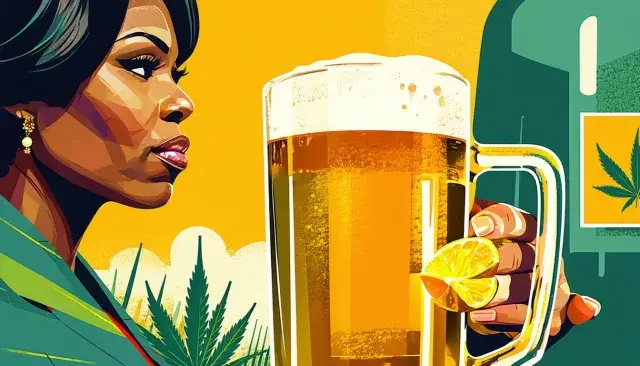
Washington Mayor Muriel Bowser has introduced legislation that would let the district's licensed breweries and distilleries produce cannabis-infused, alcohol-free beverages for sale through D.C.'s medical dispensary network - a proposal designed to ease a manufacturing bottleneck that has constrained the city's expanding medical cannabis market. The bill, formally titled the Medical Cannabis Beverage Product Amendment Act of 2026, was filed April 2 by D.C. Council Chairman Phil Mendelson on the mayor's behalf.
What the Bill Actually Does
The structure here is more surgical than it might first appear. Breweries and distilleries wouldn't be selling cannabis products themselves - they'd be functioning as contract manufacturers. Under an endorsement agreement, an alcohol producer would receive cannabis or THC from a licensed medical cannabis manufacturer, produce the beverage, and return it to that same manufacturer for distribution. Sales would flow exclusively through licensed dispensaries to qualifying patients or caregivers. Direct-to-consumer sales from breweries, bars, restaurants, or grocery stores? Strictly off the table.
The licensing costs are deliberately modest. Alcohol producers seeking the endorsement would pay a $500 annual fee; licensed cannabis manufacturers or cultivators wanting to import nonintoxicating, federally compliant cannabinoids for product development would pay $1,000 annually. All finished beverage products must clear laboratory testing before distribution. A 6% retail sales tax would apply, with revenue deposited into the city's general fund.
"This is an opportunity to support two local industries and to keep business in D.C.," Bowser said. Fred Moosally, director of the city's Alcoholic Beverage and Cannabis Administration, called the proposal "the logical next step in maturing D.C.'s medical cannabis marketplace."
The Regulatory Tangle Underneath
To understand why this bill takes the shape it does, you have to understand D.C.'s peculiar cannabis situation - one that has no real parallel among U.S. states. District voters approved adult-use legalization in 2014 through Initiative 71. What they got was possession and gifting without a functioning commercial market, because Congress intervened almost immediately.
In 2015, Representative Andy Harris of Maryland attached what became known as the "Harris Rider" to federal spending legislation - a provision blocking the district from taxing or regulating commercial adult-use cannabis sales. It has been renewed in every subsequent appropriations cycle. President Trump's fiscal year 2027 budget proposal, filed with Congress on April 3, keeps it in place.
The thing is, Bowser found a way around this. In 2022 she signed emergency legislation allowing any adult 21 or older to self-certify as a medical cannabis patient without a physician's recommendation - effectively folding the adult-use population into the medical system. Later that same year, she extended temporary self-certification to non-district residents as well. The result: the district went from seven licensed dispensaries four years ago to 68 today. That is a tenfold expansion, and the manufacturing infrastructure hasn't kept pace. The beverage bill is, in part, a supply-side response to that growth.
A Broader Shift in the Cannabis Market
Cannabis beverages have been gaining ground as a product category across legal markets - valued precisely because they offer a smoke-free, dose-controllable consumption format that appeals to patients managing conditions where smoking is contraindicated or simply undesirable. For medical cannabis programs specifically, that matters. Edibles and tinctures have filled some of this space, but beverages carry distinct pharmacokinetic properties; onset times and absorption profiles differ from solid ingestibles, which is clinically relevant for patients calibrating symptom management.
What makes D.C.'s approach noteworthy is the decision to route production capacity through existing alcohol manufacturers rather than build it from scratch within the cannabis industry. Breweries and distilleries already hold the equipment, quality controls, and regulatory compliance culture for producing consumable beverages at scale. The expertise transfers cleanly to alcohol-free formulations. In practice, though, the real test will be whether the cannabis and alcohol industries - two sectors with historically separate regulatory frameworks, supply chains, and professional cultures - can execute partnership agreements smoothly enough to actually move product.
The bill has not yet passed. Its path through the D.C. Council will determine whether this particular approach to cannabis manufacturing diversification becomes a model other restricted jurisdictions watch closely - or a reminder that even well-structured proposals can stall in committee.