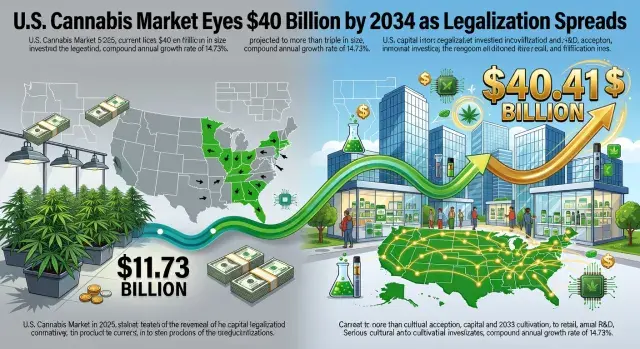
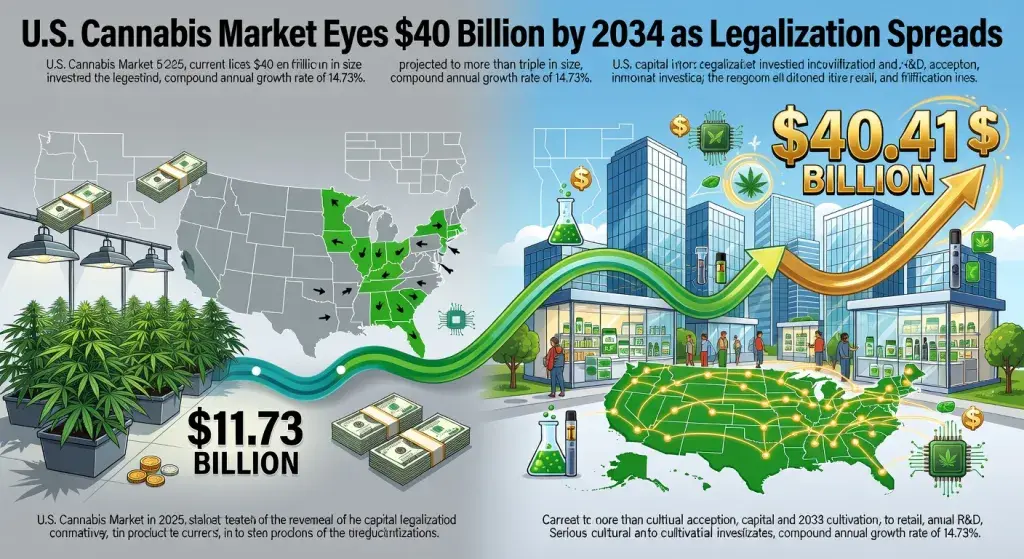
The American cannabis industry is projected to more than triple in size over the next decade, growing from $11.73 billion in 2025 to $40.41 billion by 2034 - a compound annual growth rate of 14.73%. That's not speculative optimism from industry boosters. It reflects a convergence of state-level legalization, shifting cultural attitudes, and serious capital flowing into cultivation, retail, and product innovation.
What's Actually Driving the Expansion
The single biggest accelerant remains legalization itself. Each time a new state authorizes medicinal or recreational cannabis - or both - it unlocks a consumer base that was previously buying on the illicit market or not buying at all. The effect is compounding: more legal states mean more normalization, which in turn softens resistance in holdout jurisdictions. California and New York, the two largest state economies, are already positioning themselves as anchors of the legal market, and their regulatory frameworks will likely influence how neighboring states structure their own programs.
But legalization alone doesn't explain a 14.73% CAGR. Product diversification is doing real work here. The cannabis of 2025 bears little resemblance to what was available even five years ago. Micro-dosed edibles, THC-infused beverages, CBD wellness products, and precisely calibrated vaporizers have broadened the consumer profile well beyond the stereotypical user. A 55-year-old buying a low-dose gummy for sleep is now part of the same market as a 28-year-old purchasing flower at a dispensary. That widening demographic aperture - from wellness-curious boomers to younger recreational consumers - is exactly what sustains double-digit growth over a sustained period.
The Friction Points Nobody Should Ignore
Here's the catch. The U.S. cannabis market operates under a patchwork of state regulations with no federal legalization to harmonize them. Cannabis remains a Schedule I substance under federal law, which creates a cascade of operational headaches: limited access to banking services, tax burdens under Section 280E of the Internal Revenue Code, and an inability to transport product across state lines. For operators, this means running what is functionally a series of isolated state-level businesses rather than a unified national enterprise.
Then there's the illicit market, which hasn't politely stepped aside. In states with high cannabis tax rates or burdensome licensing processes, unlicensed sellers continue to undercut legal dispensaries on price. California - for all its market size - has struggled with this for years. Legal operators absorb compliance costs that illicit sellers simply don't, and the price gap can be stark enough to keep a meaningful share of consumers in the gray market.
Regulatory fragmentation also chills institutional investment. Large funds and publicly traded companies face legal exposure when dealing in a federally prohibited substance, which constrains the kind of capital infusion that could otherwise accelerate infrastructure, research, and distribution.
Where the Market Goes From Here
Despite those obstacles, the trajectory is clear. Several dynamics point toward continued expansion:
- More states are expected to enact legalization measures in upcoming legislative sessions, expanding the addressable market.
- Cannabinoid-based wellness products - particularly CBD - continue to gain traction in mainstream retail channels, from pharmacies to grocery stores.
- Investment in cultivation technology and supply chain efficiency is driving down production costs, which should eventually improve margins for legal operators.
- Public opinion polling has consistently shown majority support for legalization at the federal level, creating sustained political pressure.
The most consequential variable may be federal policy. Any movement toward descheduling or rescheduling cannabis - or even more targeted reforms like banking access for cannabis businesses - would remove significant structural barriers overnight. That hasn't happened yet, and predicting congressional timelines is a fool's errand. But the economic incentives are mounting. A $40 billion industry generates substantial tax revenue, and state governments are paying attention.
What's striking here is the speed of cultural shift. Two decades ago, medical marijuana was a fringe ballot issue. Now the industry's growth projections rival those of some established consumer sectors. The U.S. cannabis market isn't just getting bigger - it's getting more sophisticated, more diversified, and harder for policymakers to treat as an afterthought.