A job posting from Coalhurst Urban Leaf, a licensed cannabis retailer in Coalhurst, Alberta, looks at first glance like a routine part-time hiring notice. Look closer and it's a small case study in how much regulatory weight sits on the shoulders of a single frontline retail hire in a provincially regulated cannabis market.
Why a Budtender Posting Doubles as a Compliance Document
In Alberta, retail cannabis sales fall under the Alberta Gaming, Liquor and Cannabis Commission, and the AGLC doesn't treat budtenders as ordinary cashiers. The posting requires a Sell Safe certificate - the province's mandatory cannabis sales training - before an applicant can even be considered seriously. That's not a nice-to-have. It's a licensing condition tied to the store's ability to operate at all. Any employee handling sales, from checking identification to recommending a pre-roll over a vape cartridge, is acting as an extension of the retailer's license. Get that wrong, and the exposure isn't the employee's - it lands on the store's compliance record.
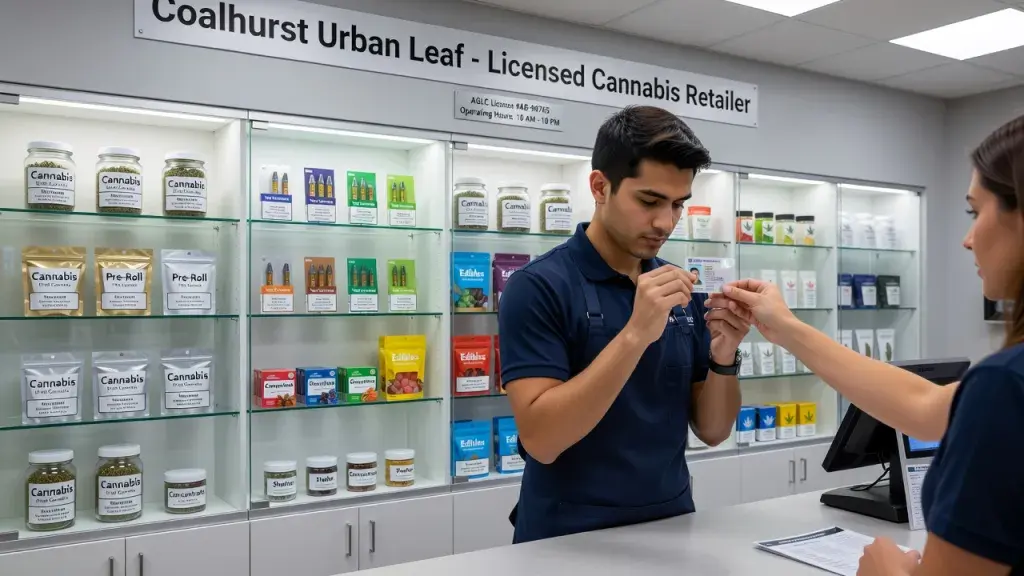
The job description bundles age verification, POS operation, and product education into a single role, which is standard for small-format cannabis retail but worth unpacking. Checking ID isn't a courtesy; it's a legal requirement tied directly to the license. A missed check, even once, can trigger a compliance file that follows a store through its next inspection or renewal cycle.
Cash Handling and POS Still Define the Job
Notice how much of the listing centers on operating the point-of-sale system and handling "cash and debit transactions accurately." That phrasing isn't filler. Cannabis retail in Canada, much like in many U.S. adult-use markets, still runs on a cash-heavy model in practice, even where debit is widely accepted, because federally regulated card networks and payment processors remain cautious about cannabis-adjacent revenue. For a small operator like Coalhurst Urban Leaf, that means till accuracy, shift reconciliation, and inventory shrinkage control sit squarely on the budtender's daily routine - not back-office staff. A single till discrepancy that seems minor on a slow Tuesday shift becomes a pattern problem if it repeats, and patterns are exactly what auditors look for.
Training Requirements Reflect a Province-Wide Standard
Alberta's Sell Safe program exists precisely because provinces learned, early in legalization, that undertrained retail staff create downstream risk - misinformed product recommendations, inconsistent age verification, and inconsistent handling of edibles and concentrates, which carry different potency and packaging rules than flower. The posting's emphasis on "willing to learn about cannabis products and regulations" signals that even experienced retail hires without cannabis-specific background need onboarding before they're trusted on the floor unsupervised.
- Mandatory Sell Safe certification before hire, not after
- ID verification tied directly to license compliance, not store policy alone
- POS accuracy and cash handling as daily compliance touchpoints
- Product knowledge spanning flower, edibles, concentrates and accessories, each with distinct packaging and labeling rules
For operators watching this listing as a hiring benchmark rather than a one-off, the lesson generalizes: in regulated cannabis retail, the budtender role isn't an entry-level service job dressed up with a trendy title. It's a compliance-adjacent position, and staffing it correctly is as much a risk-management decision as a customer-service one.